I started this blog when I was following the Life Journal Bible reading plan on YouVersion. (I've since completed that plan.) At that time, YouVersion didn't provide any way for people to respond to my notes, other than to "like" them. So this blog is here to remedy that problem. You may comment on my notes here in the comment section.
I also have a general blog.
I like this song very much. It
has a very Nusantara feel, rather than sounding like a Western Christian
song translated into Indonesian. And the term “manise” is very interesting.
Literally, it means “sweet” but in this song it is used metaphorically.
Kerja buat
Tuhan
Selalu manise
Biar pikul salib
Selalu manise
Ayo, kerja
buat Tuhan, sungguh senang-senange
Dipanggil Tuhan, selalu manise
Membuang diri ke ladang Tuhan, Saudara
Serta Tuhan, selalu manise
This song is in Ambon Malay, where
manise can mean sweet, beautiful, pleasant, lovely, delightful, or enjoyable.
So the song isn’t saying so much that “Working for God is always sweet” but more
like “serving God is always wonderful” or “serving God is always a joy.”
The line “Biar pikul salib,
selalu manise” is particularly interesting: “even bearing the cross is a joy.”
The song isn't saying that working for the Lord is always easy. Rather, it
expresses the joy of belonging to and serving Jesus even when that service
involves sacrifice.
All the believers were united in
heart and mind. And they felt that what they owned was not their own, so they
shared everything they had. The apostles testified powerfully to the
resurrection of the Lord Jesus, and God’s great blessing was upon them all.
There were no needy people among them, because those who owned land or houses
would sell them and bring the money to the apostles to give to those in need.
For instance, there was Joseph, the one the apostles nicknamed Barnabas (which
means “Son of Encouragement”). He was from the tribe of Levi and came from the
island of Cyprus. He sold a field he owned and brought the money to the
apostles.
But there was a certain man named
Ananias who, with his wife, Sapphira, sold some property. He brought part of
the money to the apostles, claiming it was the full amount. With his wife’s
consent, he kept the rest. Then Peter said, “Ananias, why have you let Satan
fill your heart? You lied to the Holy Spirit, and you kept some of the money
for yourself. The property was yours to sell or not sell, as you wished. And
after selling it, the money was also yours to give away. How could you do a
thing like this? You weren’t lying to us but to God!”
As soon as Ananias heard these
words, he fell to the floor and died. Everyone who heard about it was
terrified. Then some young men got up, wrapped him in a sheet, and took him out
and buried him.
About three hours later his wife
came in, not knowing what had happened. Peter asked her, “Was this the price
you and your husband received for your land?” “Yes,” she replied, “that was the
price.” And Peter said, “How could the two of you even think of conspiring to
test the Spirit of the Lord like this? The young men who buried your husband
are just outside the door, and they will carry you out, too.” Instantly, she
fell to the floor and died. When the young men came in and saw that she was
dead, they carried her out and buried her beside her husband. Great fear
gripped the entire church and everyone else who heard what had happened.
O: Dishonesty and desire for praise
turned a commendable thing into something that strikes the fear of the Lord in
the hearts of everyone in the church.
Jim Bakker was a televangelist
who led the PTL (Praise The Lord) ministries but he was brought down by a sex
scandal and then later put in jail for financial fraud. Later, a Christian
leader, John Bevere, visited him in jail and asked him when he lost his love
for Jesus, to have committed such sins. Jim said he didn’t ever lose his love
for Jesus – he lost the fear of the Lord.
A: We tend to talk about the Love
of God these days much more than the Fear of the Lord. Both are true. Fear of
the Lord is not just awe, though that’s true as well. But Yahweh is a just God,
though He is also merciful. I find it relatively easy to trust God’s love, but
I must also remind myself of the Fear of the Lord.
As C. S. Lewis puts it through Mr
Beaver's description of Aslan, “He’s not safe. But he’s good.” God is good, but
He is not tame. His love does not make Him less holy or less worthy of
reverence. I need to remind myself of the fear of the Lord—not as a rejection
of His love, but as a recognition of His holiness and authority—so that I will
turn away from sin rather than take His grace for granted.
P: Father, thank You that You love
us. Help me to remember also to fear You, recognise Your holiness, take Your
commands seriously, and stay away from sin. Remind me of this whenever
temptation beckons. In Jesus’ name, amen.
A big objection some people have against the historicity of
Esther is that secular history doesn’t seem to mention this, though there may
be some allusions to it.
Also, the idea of Haman’s proposal goes against how Persians
usually treated minorities in their empire. They generally had a policy of
tolerance unless you rebel. If you are willing to submit to their rule, they
generally let you keep your culture, religion etc. because this makes people
less likely to rebel. However, this does not mean that persecution of a
particular ethnic group by an individual official would have been impossible.
So the allegation is that there was by the time of the
Maccabees this festival of Purim, and Esther was a fairy tale made up to
explain it.
But the lack of clear secular corroboration is not proof
against Esther’s historicity. Ancient records are fragmentary, and Persian
royal inscriptions were normally propaganda, celebrating kings, building works,
victories, and divine favour—not palace scandal, an attempted empire-wide
massacre, or a king’s humiliating reversal of policy. Herodotus is the major
surviving Greek narrative source for Xerxes’ reign, but his interest was
chiefly in the Persian Wars and Greek interaction with Persia; he had no reason
to record every internal matter of the royal court. He mentions Amestris, a
prominent queen associated with Xerxes, and some have speculated that she could
be Esther. However, that identification is far from clear and is generally
considered unlikely.
However, the book of Esther, both in the Hebrew version and
in the extra parts found only in the Greek version, have intimate details of
Achaemenid Persian courtly life and practices that the average Jews of the
Maccabean period would not know. These include features such as the king’s
seven senior advisers, royal banquets, the organisation of the royal women’s
quarters and eunuchs, restrictions on access to the king, the golden sceptre,
royal seals, written decrees sent throughout the empire, scribal practices, and
other aspects of court protocol. Several of these features have parallels in
what is independently known about Achaemenid Persia from Greek sources, Persian
evidence, and archaeology.
Someone familiar with the Achaemenid Persian court would have found it much easier to get such details right, whereas an ordinary Jewish writer in the Maccabean period, centuries after the fall of the Persian Empire, would have needed access to old documents or well-preserved traditions that were difficult to obtain. There was no public database, no mass printing, and no convenient library where one could simply look up Achaemenid court protocol—and, of course, no Google or AI like we have today to search for this information 😅. Records were handwritten on scrolls or tablets, scattered among official archives and elite collections, often far away and in foreign languages. Access would have required unusual connections, resources, travel, and literacy.
So while the form of Esther we have today in the Hebrew and
Greek are probably from the Maccabean or Hellenistic period, the core story probably came from the
Persian period. The text that Lysimachus son of Ptolemy translated into
Greek probably had those details because it’s unlikely for Lysimachus to have
known those details centuries after the fall of the Persian
empire. In fact, Lysimachus shows his unfamiliarity with that period because he got the name of the king wrong—he wrote
Artaxerxes instead of Xerxes, perhaps because of the similarity of the names in Hebrew—and yet got the Persian courtly details right. This strongly supports the idea that his source text for translating Esther had those details.
So, while from the historical evidence alone, one cannot
conclusively prove Esther to be historical, I think that, given the balance of
probabilities, the evidence suggests that Esther is more likely to be
historical than to be a myth made up by a Maccabean-era Jew to explain the
festival of Purim. Its Persian setting, courtly knowledge, administrative details, and coherent historical context are better explained by authentic tradition rooted in the Persian period.
S: Hosea 11:12 Ephraim has surrounded me with
lies, and the house of Israel with deceit; and Judah is still wandering with
God and is faithful to the Holy One.
2 verses later, Hosea 12:2 Yahweh has a
quarrel with Judah and will punish Jacob according to his ways and repay
him according to his deeds.
O: At the end of Chapter 11, Judah
was looking good compared to Ephraim (Israel). But was Judah really good? 2
verses later, the situation is revealed when Yahweh declares that He has a
quarrel with Judah and will punish Jacob (all of Israel – both north and south).
Judah may not have reached Ephraim’s depth of rebellion, but Judah too stands
accountable before God.
A: Sometimes we look good when we
compare ourselves with people who have done things that are more visibly evil
than us. But as Jesus said, “Why do you call me good? No one is good
except God alone” (Mark 10:18). We cannot think we are good because we’re
better than someone else, “for all have sinned and fall short of the glory of
God” (Romans 3:23). He “does not want
any to perish, but all to come to repentance” (2 Peter 3:9) so we instead of
trying to condemn evil people, we need to follow God in seeking their repentance.
This is not to say that there
should not be laws and government action to punish crimes, but I’m speaking at
an interpersonal level. We should be seeking to draw all to repentance and to
follow God, rather than revenge.
P: Father, when people upset me,
it’s hard to keep in mind Your desire for their repentance rather than their
death. Remind me to see other people through Your compassionate eyes that do
not tolerate injustice yet extends grace. In Jesus’ name, amen.
S: Hosea 4:14“I will not punish your daughters when they turn to prostitution, nor your daughters-in-law when they commit adultery, because the men themselves consort with harlots and sacrifice with shrine prostitutes—a people without understanding will come to ruin!”
O: Along with the incident with Judah and Tamar in
Genesis 38:26 God condemns the hypocrisy of going after prostitutes instead of
the pimps and johns. Most of the time, prostitutes are victims of human
trafficking and/or difficult circumstances, while the pimps and johns chose to
victimise them.
Ecclesiastes (Vanity of vanities and all kinds of vanity) by Isaak Asknaziy, 1900.
S: Ecclesiastes 1
The words of the Teacher, the son
of David, king in Jerusalem.
“Vanity of vanities!” says the
Teacher, “Vanity of vanities! All is vanity!”
What does a person gain in all
his toil with which he toils under the sun? A generation goes, and a generation
comes, but the earth stands forever. The sun rises, and the sun goes down; to
its place it hurries, and there it rises again. The wind goes to the south and
goes around to the north; around and around it goes, and on its circuit the
wind returns. All the streams flow to the sea, but the sea is never full; to
the place where the streams flow, there they continue to flow.
All things toil continuously; no
one can ever finish describing this. The eye is never satisfied with seeing,
and the ear is never filled with hearing. What has been—it is what will be;
what has been done—it is what will be done; there is nothing new under the sun.
There is a thing of which it is said, “Look at this! This is new!” But it
already existed in ages past before us. There is neither remembrance of former
generations, nor will there be remembrance of future generations.
I, the Teacher, was king over
Israel in Jerusalem. I applied my mind to seek and to search by wisdom all that
is done under the heavens. It is a grievous task God has given to humans. I saw
all the works that are done under the sun. Look! Everything is vanity and
chasing wind. What is twisted cannot be straightened, and what is lacking
cannot be counted.
I said to myself, “Look! I have
become great and have increased in wisdom more than anyone who has preceded me
over Jerusalem. I have acquired a great deal of wisdom and knowledge.” So I
dedicated myself to learn about wisdom and to learn about delusion and folly.
However, I discovered that this also is chasing wind. For in much wisdom is
much frustration, and whoever increases knowledge increases sorrow.
O: Ecclesiastes chronicles the struggles
Qoheleth (the Teacher in the above translation, from the Hebrew קֹהֶלֶת) as he seeks to
understand the world that God had made.
If Qoheleth was Solomon, as many
people have traditionally assumed, then what a tragic story it would be.
Solomon started out well, asking God for wisdom, but later drifted away from
Yahweh and worshipped other gods. Ecclesiastes could then be understood as the
reflections of an old man looking back on a life in which he had pursued
wisdom, wealth, pleasure and achievement, only to discover that none of them
could provide ultimate meaning. But even if he wasn’t Solomon, the observations
remain valid.
Ecclesiastes shows how
meaningless life is if you don’t have God’s purpose in your life. Here in
Chapter 1, like the ending lyrics of Queen’s Bohemian Rhapsody, Qoheleth bemoans how “nothing ever
matters,” because no matter how much you toil, “there is nothing new under the
sun.” Like Percey Shelly points out in his classic poem Ozymandias, you can be great in your time, build
great monuments to yourself, but time will erase them.
He talks about how “in wisdom
there’s much frustration and whoever increases knowledge increases sorrow.”
Indeed, if Qoheleth is Solomon, what a great example of that he was! God gave
him great wisdom, and he squandered it as he drifted away from Yahweh.
Then in Chapter 2, he gives
himself over to hedonism, the wealth acquisition (again, if Qoheleth is Solomon,
this fits with the historical record of Solomon’s reign being extremely
prosperous) yet even that’s no ultimate fulfilment and he ends Chapter 2 by
saying it’s “chasing after the wind.”
The despair and meaninglessness go
on like that in chapters 3-11, until he finally realises in chapter 12, after “all
has been heard” that the conclusion is “Fear God and obey his commandments, for
this is the whole duty of man.For God
will bring every deed into judgment, including every secret thing, whether good
or evil.”
A: We don’t have to live Solomon’s
wayward wasted life to figure out the conclusion. Let us fear God and obey His
commandments now. Then only we will live the purpose-driven life (as Rick
Warren puts it.)
Where Qoheleth asks, “What is
the point of life if everything ends in death?” Warren answers, “Life
makes sense when you understand that it is ultimately about God, not yourself.”
It’s not about you (or me.) The
way to have a meaningful life is to live for God:
Worship: we were planned for
God’s pleasure.
Fellowship: we were formed for
God’s family.
Discipleship: we were created to
become like Christ.
Ministry: we were shaped for
serving God.
Evangelism: we were made for a
mission.
So our purpose isn’t primarily to
achieve, accumulate, experience pleasure, or leave a legacy, as Qoheleth
struggled with. It is to God, love God, become like Christ, serve others and
participate in God's mission.
And because Christ has conquered
death, our labour for Him is not ultimately futile:
Therefore, my dear brothers and
sisters, stand firm. Let nothing move you. Always give yourselves fully to the
work of the Lord, because you know that your labour in the Lord is not in
vain.
— 1 Corinthians 15:58
P: Father, thank You that Qoheleth
is wrong when he said life is vanity. Life is not vanity if we live for
You. Help me to live for You. Help me encourage my family and friends to live
for You. And thank You that, because of Christ, our labour in You is not in
vain. In Jesus’ name, amen.
Note: I wrote this and then showed it to various AIs, both
Christian and secular and made a few changes where I agreed with the Ais’
suggestions. So the ideas and most of the text is my own writing.)
O: Everyone is imperfect, but the
book of Nehemiah points out Nehemiah’s imperfections a bit more starkly than most
autobiographical books. It shows his insecurity, his intemperance, and his exclusionary
attitude toward foreigners, 4 times he kept asking God to “remember me” (Nehemiah
5:19; 13:14, 22, 31) and various intemperate actions like beating people up and
pulling out their hair (Nehemiah 13:25).
(Regarding his attitude toward
foreigners: Nehemiah 13 uses sweeping reform language because Nehemiah was
enforcing covenant separation from hostile and corrupting foreign influence.
However, the wider witness of Scripture shows that this cannot mean the
absolute exclusion of every Ammonite or Moabite who genuinely turned to Yahweh.
Ruth had already demonstrated that covenant faith, not ethnic origin,
determines membership among God's people. And his forcing the Jews who have
married foreign wives, even those having children, to divorce them was later
shown in 1 Corinthians 7:12-13 to be not the way Christ would want it.)
And yet, God remembered him and
used him to further the kingdom of God.
A: Sometimes we become
discouraged when we realise how imperfect we are. Yes, we should repent
and get closer to the image of Christ. But we should not despair. Instead, let
us continue to serve Him faithfully, trusting that He can use us despite our
imperfections.
P: Father, thank You for Your
grace. Help us to become more and more conformed to the image of Christ. In
Jesus’ name, amen.
The Levites recapped what Yahweh
had done for Israel up to that point, how God rescued them from Egypt, but then
they went and made the golden calf, yet God took the next generation to the
Promised Land. But even after entering the Promised Land, they repeatedly
turned away from Yahweh. Though He sent prophets to warn them and call them
back, they remained stubborn, so God judged them and allowed them to be taken
into exile. Yet God did not abandon them. In His mercy He brought them back to
their land.
O: This reminds me of Acts 7,
where Stephen also recapped the history of God saving them, culminating in the very
same Jesus that they had rejected.
I am also reminded of how in
Deuteronomy, Moses recapped what God had done for them up to that point. (In
fact, the Malay name for Deuteronomy in the Alkitab is Ulangan,
which is the same word we use for reviewing what we have learned before an
exam.) And many other places in the Old Testament, they build memorials here
and there to remember what God had done, e.g. 1 Samuel 7 the story of Ebenezer.
A: We need to keep reminding
ourselves of what God has done, because it is so easy for us to drift away and
forget how He saved us. That’s why it’s so important to study the Bible regularly,
to meet with other believers among whom the Word of God is taught. As Deuteronomy
6:7 says, “And you shall recite them to your children, and you shall talk about
them at the time of your living in your house and at the time of your going on
the road and at the time of your lying down and at the time of your rising up”
and the same instructions are repeated in Deuteronomy 11:19.
P: Father, thank You for Your
salvation that You have provided us through Jesus. Help me to keep reminding
myself, my family, and my community of believers of Your truths and never
forget Your blessings. In Jesus’ name, amen.
Ezra led the returning Jews to
repent of marrying foreign women, and divorce their foreign wives, even those
who already had children.
O: Even in the Old Testament, it’s clear that
this is not a case of racism, but of faith. The problem with the foreign wives
was not race or nationality – it was that they did not follow Yahweh. There are
other examples in the Old Testament where foreigners follow Yahweh and God
sanctioned them marrying in, e.g. Ruth.
However, the New Testament made it even
clearer: 1 Corinthians 7:39 “A woman is bound to her husband as long as he lives.
But if her husband dies, she is free to marry anyone she wishes, but he must
belong to the Lord.” The phrase “in the Lord” shows that a Christian who is
free to marry must marry someone who belongs to Christ.
Note that the New Testament also
makes it clear that if you’re already married to an unbeliever, you are not to
initiate a divorce. 1 Corinthians 7:12-16 “Now to the rest I say—not the
Lord—if any brother has an unbelieving wife and she consents to live with him,
he must not divorce her. And if any wife has an unbelieving husband and he
consents to live with her, she must not divorce her husband. For the
unbelieving husband is sanctified by his wife, and the unbelieving wife is
sanctified by the brother, since otherwise your children are unclean, but now
they are holy. But if the unbeliever leaves, let him leave. The brother or the
sister is not bound in such cases. But God has called us in peace. For how do
you know, wife, whether you will save your husband? Or how do you know,
husband, whether you will save your wife?”
A: While being married to a
non-believer is a problem because of the spiritual disunity, it’s even worse to
break up a marriage just because the spouse is not a believer. This is
especially the case when there are already children. So, what Ezra led the returning
Jews to do is not what we should do as New Testament believers.
If we’re not married yet, and we want to marry,
we should marry a fellow-believer. The principle from 2 Corinthians 6:14 applies: “Do not become
unevenly yoked with unbelievers, for what participation is there between
righteousness and lawlessness? Or what fellowship does light have with
darkness?” Although 1 Corinthians 6:14 is not specifically about marriage, but
rather about partnerships in general, what more intimate partnership is there
other than marriage? So, it also applies to marriage.
P: Father, strengthen our
marriages. Give wisdom to our single brothers and sisters to find Godly spouses
if they desire to marry. And help those who are already in “unequally yoked”
marriages to be such a blessing to their family that they be drawn to You. As I
am married to a fellow believer, I pray that I will also be a good husband;
help me to love her as Christ loves the church and gave Himself up for her. In
Jesus’ name, amen.
Now the enemies of Judah and
Benjamin heard that the returned exiles were building a temple for Yahweh
the God of Israel. And they approached Zerubbabel and the heads of the
families, and they said to them, “Let us build with you. Like you, we seek
your God and have been sacrificing to him from the days of Esarhaddon the king
of Assyria who brought us up here. But Zerubbabel, Jeshua, and the rest of
the heads of the families of Israel said to them, “It is not for you but
for us to build a house for our God. For we ourselves alone will build it for
Yahweh the God of Israel, just as Cyrus the king of Persia has commanded us.”
Then the people of the land
discouraged the people of Judah and made them afraid to build and
bribed officials against them to frustrate their plan for all the days of Cyrus
king of Persia until the reign of Darius king of Persia.
O: This was a major step in the
increase of the enmity between the Jews and the people who would be eventually
known as Samaritans, to the point that by Jesus’ time, they would have nothing
to do with each other. There may already have been some prejudice before that
due to the fact that the Samaritans had a syncretistic form of Yahweh worship,
but it certainly got a lot worse in Ezra’s time. Praise the Lord that Jesus
then overcame this with the Samaritan woman at the well in John 4:1-42. The Samaritans
came to Christ in droves as a result of that.
Because of the enmity between the
Jews and Samaritans that started with Ezra above, many Jews when travelling
from Judea to Galilee would actually cross over the Jordan to Perea, and travel
on the east side of the Jordan till they got far enough north to cross back
over to Galilee. Jesus did not do that. He deliberately travelled through
Samaria and germinated the Samaritan revival.
It may have been after that
Samaritan revival that Luke 9:51–56 records some Samaritans not welcoming him
because he was headed for Jerusalem – the Samaritans’ own prejudices against
Jews reared its ugly head. James and John, the “Sons of Thunder” as Jesus
called them in Mark 3:17, in their hot-headedness, wanted to call down fire
from heaven to destroy them, but Jesus rebuked them for it.
Then, not long after that, Jesus
in Luke 10:25-37 makes a Samaritan the hero of the story in the Parable of the
Good Samaritan. Then in Luke 17:11-19 we see the healing of the ten lepers,
where only the Samaritan comes back to thank Jesus. And finally in Acts 1:8,
just before He gets taken up into heaven, Jesus commands His disciples to witness
to Samaria as part of the Great Commission.
The result of all this was a
reconciliation between at least the Christian Jews and the Christian
Samaritans. Acts 8 tells the continuing story where Philip went to another city
in Samaria and led many to Christ there, and Peter and John laid hands on them
and they received the Holy Spirit.
A: We are surrounded by people who do not believe in Christ.
Some of them are hostile to our faith. We might have prejudices against them, just like the Jews had towards Samaritans. Jesus calls us to show them His love, rather than hostility. Even as we hold
firmly to Christ, we must show His mercy to all.
P: Father, help me to always be a
good ambassador for Christ, and to show people Jesus’ love. Help me to overcome
any prejudices I may have. In Jesus’ name, amen.
S: Mark 13:9-13 “You must watch
out for yourselves. You will be handed over to councils and beaten in the synagogues.
You will stand before governors and kings because of me, as a witness to them. First
the gospel must be preached to all nations. When they arrest you and hand you
over for trial, do not worry about what to speak. But say whatever is given you
at that time, for it is not you speaking, but the Holy Spirit. Brother will
hand over brother to death, and a father his child. Children will rise against
parents and have them put to death. You will be hated by everyone because of my
name. But the one who endures to the end will be saved.
O: Three major ideas here are
backed up by many other parts of the New Testament:
The
Gospel will be preached to all ethnic groups. “Nations” (Greek: ἔθνη) refers not to modern
countries but to ethnic groups.
Our
faith will be challenged, but we should not worry, for the Holy Spirit will
guide us.
It’s
not “once saved, always saved”. While we are saved by grace through faith and
not by our own works, Scripture also calls us to remain faithful to Christ to
the end. You can’t say “I received Christ back then, so I’m saved no matter
what I do now.”
A: I must do my part to share God’s
love with people who have yet to know Him. Christ Himself told us that the
Gospel must be preached to all ἔθνη
– so the Church’s mission is still incomplete. This is why I am sceptical
whenever people confidently insist that Jesus must return within a particular
timeframe. I lived through the “88 reasons why Christ must return in 1988”
craze, and such failed predictions can damage people’s faith unnecessarily.† As
Augustine of Hippo wrote around 419 AD, it cannot be said that Christ's return
is immediately upon us while His own sign—the preaching of the Gospel to all
nations—remains unfulfilled. (Paraphrasing Augustine’s Letter 199.) This
remains true today, though we are all called to do our part in proclaiming the
Gospel. We are all ambassadors for Christ – it’s not only the job of the “official”
evangelists to share the Gospel.
The Holy Spirit will guide us, as
this and other passages promise. This is not an excuse to neglect study,
wisdom, or preparation, but it does mean we need not be ruled by fear.
And finally, we must be steadfast
in Christ. We must daily take up our cross and follow Him. When we sin, we must
repent and turn back to Him. We must not indulge or wallow in sin. If we
confess our sins, God is faithful and just to forgive us of our sins and cleanse
us from all unrighteousness, so let’s make sure to confess to God and repent.
P: Father, thank You for Your
salvation. Thank You that when I sin, You are faithful to forgive as I repent
and turn back to You. May I be Your good and faithful servant and ambassador.
May my lips be guided by Your Holy Spirit to share Your good news. May I be
salt and light for You. In Jesus’ name, amen.
† This should never become an
excuse for complacency (see also Matthew 25:1–13). Even if Jesus does not
return during your lifetime, you will still meet Him. We may "meet our
Maker" today through death, so we must always remain watchful and
steadfast in Christ.
O: In the first passage, a desperate
father brought his suffering son to Jesus’ disciples, but they could not heal
him. His son had suffered since childhood, so this father had likely carried
years of grief, disappointment, and exhausted hope. Then he heard about this miracle-working rabbi
and thought maybe this was finally a way out.
However, when he brought his son to them, the
disciples failed to heal him, he was disappointed yet again. No wonder when
Jesus finally showed up (after the transfiguration! But he didn’t know that) he
said, “But if you can do anything, take pity on us and help us.”
Jesus almost sounded offended, “If you can?
Everything is possible for one who believes.”
No wonder the father desperately cried, “I
do believe; help me overcome my unbelief!” He didn’t have much faith at that
point, but he was desperate, and he brought the little faith he had to the
right person.
And Jesus demonstrated His power
and healed the boy.
Then in the second passage, Jesus
saw a fig tree that was “in leaf” but had no fruit. Fig trees of the kind found
in Israel can produce early small figs, sometimes called “early figs” or
“breba” fruit, before the main crop. These early figs may appear around the
time the leaves come out. So, if you see a tree full of leaves before the main
season, you would expect there to be some early fruit.
This became a living parable of
the religious leaders and the Temple establishment. They had the appearance
of faith but no spiritual fruit. They had the leaves but no figs. So they fell
under the curse the same way as illustrated by the fig tree Jesus cursed.
The tree looked fruitful from a
distance because it was leafy, so it invited inspection, but it proved
barren—making it an apt symbol for outward religiosity without corresponding
fruit.
A: In the first story, the man
didn’t have any polished religious image. He had no beautiful robes, no fancy
theology. Even his faith was frayed, mixed with unbelief. But he was desperate,
and he put his trust in Jesus. Jesus showed mercy and healed his son, in spite
of his imperfect faith.
In the second story, the priests,
scribes, Sadducees and Pharisees had plenty of religious sophistication, but
they rejected Jesus, having no true faith and fruit as a result – and so they
fell under the curse of the fig tree. This also was repeated many times through
history as churches became so caught up in the pomp and pageantry of official sanction
but did not have the fruit of the Holy Spirit.
Therefore, we should trust Jesus
even if our faith is imperfect, rather than being caught up in religiosity. This
is not to say that you cannot have true faith if you’re in a formal traditional
church. You certainly can. And it’s certainly possible to have fake faith for
show only in a “contemporary” church. What matters is the heart, sincere trust
in Jesus, however imperfect or desperate.
P: Father, thank You for Your
grace that overcomes our imperfections. I confess that my faith is often
imperfect and have mixed motives. May I always be sincere and following You,
even in my shortcomings. I repent of my sins and put my trust in You. In Jesus’
name, amen.
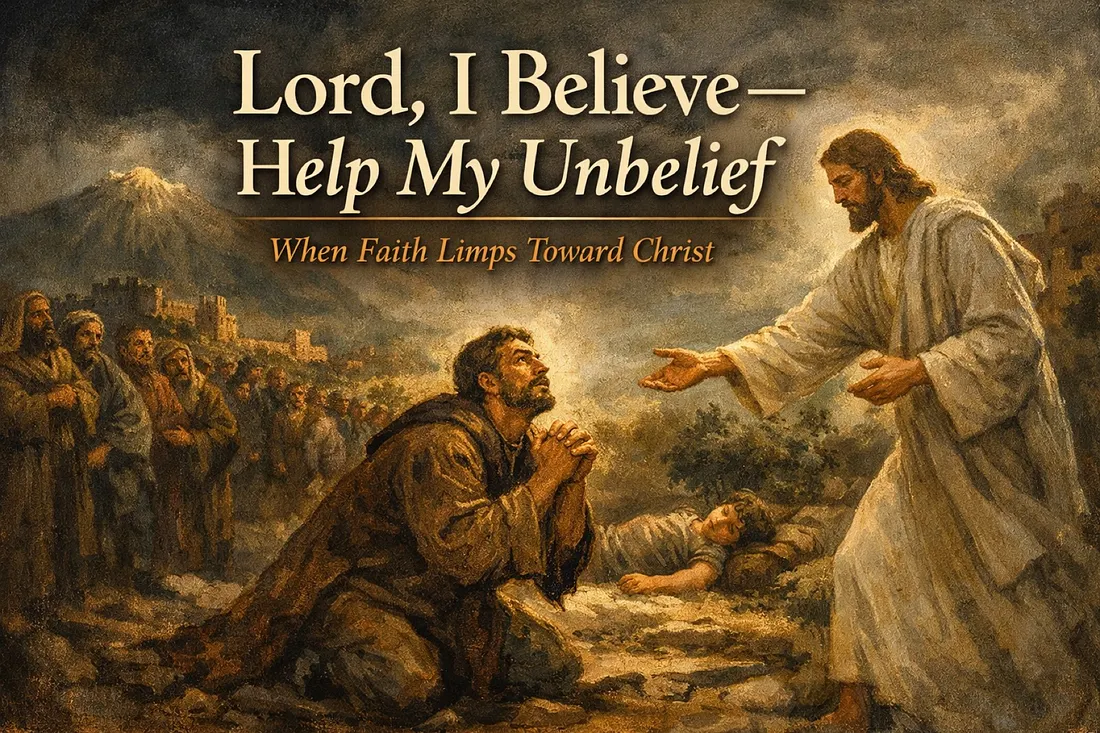
Today, instead of my usual Friday SOAP, my meditation on Mark
9:14-39 became the start of a song. Right now, I only have come up
with the lyrics; haven’t figured out the music yet. (I might modify the lyrics
when I put it to music later, I dunno yet.)
I was meditating on the passage, when it occurred to me, all
the songs I know about “I believe, help my unbelief” are meditative, reflective
songs. But in the original situation, the phrase is not a meditative phrase – it was a cry of desperation! The father wasn’t reflecting on faith – he was in
despair that his son would ever be healed! The disciples had failed. Could
Jesus do it? He didn’t know! That’s why he said what he said to Jesus.
So I tried to come up with a song that echoed that
desperation.
Coming down the mountainside,
The Lord beheld the scene;
The scribes and disciples argued there,
A crowd stood in between.
A father stepped before the Lord,
His voice was weak with grief:
“Teacher, I brought my only son,
But they brought no relief.”
[Verse 2]
“Since he was but a little child,
A spirit troubles him;
It casts him into fire and streams,
And leaves his body grim.
I begged Your followers for help,
To set my poor boy free;
They failed to drive the spirit out.”
He said, “Bring him to Me.”
[Chorus]
Lord, I believe! Help my unbelief!
My doubt is heavy and my trust is small.
I bring no mighty faith to win relief,
Just a shattered hope, and yet I bring it all.
I am hoping against hope You are the one,
I’m holding to the fraying edge of grief;
I have nothing left to offer for my son,
But “I believe, oh, help my unbelief!”
[Verse 3]
The spirit saw the Saviour near,
And threw him to the ground;
He writhed and foamed before them all,
While crowds stood gathered round.
“How long has he been suffering so?”
The Lord in mercy said.
“Since childhood, Lord, and every year
I’ve lived with fear and dread.”
[Verse 4]
“If You can do a thing for us,
Have mercy, Lord,” he cried.
Jesus answered, “If I can?
Why let your faith now hide?
All things are possible indeed
For those who will believe.”
Then tears broke from the father’s eyes,
This mercy to receive:
[Chorus]
Lord, I believe! Help my unbelief!
My doubt is heavy and my trust is small.
I bring no mighty faith to win relief,
Just a shattered hope, and yet I bring it all.
I am hoping against hope You are the one,
I’m holding to the fraying edge of grief;
I have nothing left to offer for my son,
But “I believe, oh, help my unbelief!”
[Bridge]
Not a perfect faith,
Not a fearless heart,
Just a father on his knees.
Lord, I cannot save my son,
So I beg you, Jesus, please.
[Verse 5]
Jesus saw the crowd draw near,
And spoke a stern command:
“You deaf and mute spirit, depart,
And leave at My demand.”
The spirit shrieked and left the boy,
Who lay as one long dead;
But Jesus took him by the hand,
And raised him up instead.
[Chorus 2]
Lord, I believe! Help my unbelief!
When shadows fall and future trials arise,
I will remember how You brought relief,
And chased the ancient terror from his eyes.
I will anchor to the victory You have won,
How You rescued us from tragedy and grief;
When You reached Your gentle hand to raise my son,
Lord, I believe! Oh, help my unbelief!
[Outro]
In the valley after glory,
In the struggle after light,
The Saviour meets the trembling soul,
And leads it through the night.
Note: I used several discussions with various AIs to help work through the ideas and help me with rephrasing my ideas with rhyme and meter.
22 They came to Bethsaida, and some
people brought a blind man and begged Jesus to touch him. 23 He
took the blind man by the hand and led him outside the village. When he had
spat on the man’s eyes and put his hands on him, Jesus asked, ‘Do you see
anything?’
24 He looked up and said, ‘I see
people; they look like trees walking around.’
25 Once more Jesus put his hands on
the man’s eyes. Then his eyes were opened, his sight was restored, and he saw
everything clearly. 26 Jesus sent him home,
saying, ‘Don’t even go intothe village.’
O: Oddly,
Jesus’ healing seemed to be not complete the first time round, and he had to
heal again. But this actually makes sense, given modern research.
Neurologist
Oliver Sacks documented a case of Shirl Jennings, who was medically healed of
blindness, but his brain had difficulty processing the visual information. It
took him weeks and months to adapt to vision, and actually never managed to achieve
completely normal visual processing. [1]
Others also
documented other cases of people who had been healed of blindness needing time
to relate objects they saw with what they had only experienced before by touch.
[2]
So, perhaps
Jesus healed the blind man twice because there were two things that needed
fixing – first, the hardware: his physical ability to see, and second, the
software: his cognitive ability to process what his eyes were seeing.
During my master's research, I worked a little with machine
vision. It gave me a new appreciation for the miracle of sight. Even getting a
computer to identify simple lines in engineering drawings was remarkably
difficult. (This is now largely a solved problem; my research was decades ago.)
If recognising lines is hard, how much more remarkable is the human ability to
instantly recognise faces, trees, and people? [3]
A: Sometimes
God’s work in my life unfolds in stages. I may pray for help, healing,
guidance, or change, and the answer may not seem complete at first. Like the
blind man, I may see something, but not yet clearly.
This passage reminds me that Jesus is not limited or
struggling. He is Lord over both the miracle and the process. If His work seems
gradual, there may be reasons I do not yet understand.
The blind man was honest with Jesus. He did not pretend that
everything was clear. He simply said what he saw. I need to learn that kind of
honesty in prayer too. Instead of pretending, giving up, or becoming quietly
disappointed, I can tell Jesus where things still feel unresolved: “Lord, I can
see a little, but not clearly yet.”
I also need to keep trusting Him after the first touch.
Partial progress is not failure. It may be part of the process by which Jesus
teaches me dependence, patience, and deeper faith. My responsibility is to stay
with Him, be honest before Him, and trust Him until He brings clearer sight.
P: Father,
when Your answer seems delayed, partial, or different from what I expected,
help me not to give up or pretend. Teach me to be honest with You, to trust
Your process, and to keep looking to Jesus until I see more clearly. In Jesus’
name, amen.
References
1.Oliver
Sacks, An Anthropologist on Mars: Seven Paradoxical Tales (New York:
Alfred A. Knopf, 1995), chap. 2, “To See and Not See.” ISBN 0-679-43785-1
Held,
R., Ostrovsky, Y., de Gelder, B. et al. The newly sighted fail
to match seen with felt. Nat Neurosci14, 551–553
(2011). https://doi.org/10.1038/nn.2795
3.Chai,
I., Dori, D. (1992). Orthogonal Zig-Zag: An Efficient Method for Extracting
Straight Lines from Engineering Drawings. In: Arcelli, C., Cordella, L.P., di
Baja, G.S. (eds) Visual Form. Springer, Boston, MA. https://doi.org/10.1007/978-1-4899-0715-8_14
Note: The
ideas are mine, but I did get some help from AIs to copyedit what I wrote.
A large crowd followed and
pressed around him. And a woman was there who had been subject to bleeding for twelve
years. She had suffered a great deal under the care of many doctors and had spent
all she had, yet instead of getting better she grew worse. When she heard about
Jesus, she came up behind him in the crowd and touched his cloak, because she thought,
“If I just touch his clothes, I will be healed.” Immediately her bleeding stopped
and she felt in her body that she was freed from her suffering.
At once Jesus realised that power
had gone out from him. He turned around in the crowd and asked, “Who touched my
clothes?”
“You see the people crowding against
you,” his disciples answered, “and yet you can ask, ‘Who touched me?’”
But Jesus kept looking around to see
who had done it. Then the woman, knowing what had happened to her, came and fell
at his feet and, trembling with fear, told him the whole truth. He said to her,
“Daughter, your faith has healed you. Go in peace and be freed from your suffering.”
O: So many people were touching Jesus, bumping
into him, jostling, etc. in the crowd as Jesus made his way from the shore to
Jairus’s house. Yet one woman’s touch was different. One woman’s touch made
Jesus stop in his tracks! One woman’s touch, in faith, brought healing.
One woman’s touch.
It’s not that the people crowding around Jesus
were not interested in Jesus. They obviously were – otherwise, why would they
have come crowding around him? But there was a qualitative difference between
their interest in Jesus and that one woman’s. They were interested in
Jesus – she put her faith in Jesus.
The crowd pressed against Jesus
with curiosity and excitement. She reached for Jesus with desperate faith. Many
touched him accidentally; she touched him intentionally. For twelve years she
had lived with shame, weakness, loss, and isolation. And yet Jesus didn't
simply let the healing happen quietly. Instead, he called her forward so that
the one who had been known by her condition would now be known by his
compassion.
A: Daily I encounter Jesus. Most days, I pray
and read the Bible. But often, it’s just part of my routine. Many days, I touch
Jesus… like the people crowding against him as he walked from the shore to
Jairus’s house. How often do I touch him like that woman touched him?
P: Psalm 27:4 says “One thing I have
asked of Yahweh, that I will seek after: that I may dwell in Yahweh’s house all
the days of my life, to see Yahweh’s beauty, and to inquire in his temple.” I
admit, Father, that I do not often feel like that. I’m filled with other things
I’m seeking than to spend quiet time with you. Father, forgive me. May I learn
to be content with you above all else. In Jesus’ name, amen.
9 Then
Jesus said, “Whoever has ears to hear, let them hear.”
10 When he
was alone, the Twelve and the others around him asked him about the
parables. 11 He told them, “The secret of the
kingdom of God has been given to you. But to those on the
outside everything is said in parables 12 so
that,
“‘they may be ever seeing but never perceiving,
and ever hearing but never understanding;
otherwise they might turn and be forgiven!’[a]”
O: Jesus quotes Isaiah 6, where Yahweh
commissions Isaiah to preach to a hardened Judah. Isaiah’s preaching does not
create innocent unbelief, but exposes and confirms rebellion already present.
In the larger sweep of Isaiah, Judah’s refusal of God’s word leads toward
national devastation, exile, ultimately culminating in the Babylonian
captivity.
Jesus applies that same prophetic
pattern to His own ministry: He’s announcing the Kingdom of God, but not
everyone receives it. This is preceded by the Parable of the Sower – the same
gospel seed is sown, but the condition of the heart determines the response.
Some reject immediately, some respond shallowly, some are choked by worldly
concerns, and some truly hear, accept, persevere, and bear fruit.
Jesus is not saying, “I
arbitrarily do not want people forgiven.” He is saying that the mystery of the
kingdom is given to those who draw near to Him in faith, humility, and
repentance, while those repeating Israel’s old pattern of hardness remain blind
even while hearing. The issue is not mere intelligence. The disciples
themselves often misunderstand. The issue is the posture of the heart: whether
one comes near, asks, listens, repents, and follows.
At the same time, a person’s
heart condition is not necessarily static. People can later repent. Even in
Isaiah’s larger context, judgment does not destroy God’s mercy; a remnant
remains. Therefore, this passage warns us not to presume upon hearing the word,
but to receive it with repentance, perseverance, and fruitfulness.
A: Spiritual understanding grows as we
stay near Christ. I must not be content merely to hear God’s word outwardly. I
must receive it inwardly with repentance, faith, and obedience. I should draw
near to Christ in prayer, study of Scripture, and faithful living, trusting
that spiritual understanding deepens as I remain close to Him and bear fruit in
perseverance.
P: Lord
Jesus, I thank You
with my whole life and soul, I do
My heart belongs to You,
I know You love me true
The only sacrifice
I can bring is my soul,
my body and my heart,
You can take me whole.
My riches are like rags
compared to You, my Lord
My works are not enough
the ones I could afford.
So take my heart, O Lord,
I offer it to You
Tell me now my Lord,
what You want me to do
Receive it all my Lord,
this body that was mine
until the end of time.
Some of the teachers of the Law of Moses were Pharisees, and
they saw Jesus eating with sinners and tax collectors. So they asked his
disciples, “Why does he eat with tax collectors and sinners?”
Jesus heard them and answered, “Healthy people don’t need a
doctor, but sick people do. I didn’t come to invite good people to be my
followers. I came to invite sinners.”
…
Some Pharisees asked Jesus, “Why
are your disciples picking grain on the Sabbath? They are not supposed to do
that!”
…
Jesus finished by saying, “People
were not made for the good of the Sabbath. The Sabbath was made for the good of
people. So the Son of Man is Lord over the Sabbath.”
O:
We have a tendency to make an idol
of our own rules and interpretations of the faith, of our own tribe, and hence end
up pushing people away from Yahweh. We may excuse the wrong things people we
support do, while emphasising the wrong things people we disagree with do.
Jesus came to reconcile the ungodly
people to Yahweh. We are His ambassadors, so we should be in that same
business. But too often, we let our own prejudices get in the way of that.
A: I need to repent of my own sins,
and show God’s compassion to others, whether they are already with Christ or
still outside the family of faith. Many or most of those tax collectors and sinners
Jesus ate with were not yet converted, yet He openly fellowshipped with them. I
must show that same love and welcome as well.
P: Father, give me your heart for
those outside the family of faith. Help me to show Your love to them. Let me recognise
my own sins and grow closer to You. In Jesus’ name, amen.
𝐋𝐨𝐨𝐤𝐖𝐡𝐚𝐭𝐘𝐨𝐮’𝐯𝐞𝐃𝐨𝐧𝐞
For All The King’s People
By Rob Hibbitt
Look my people, look what you’ve done
And there is nothing new under the sun
In your freedom you’ve bowed down to gold
It′s the same story, that same story of old
Come now children, put down that calf
I want the whole heart not just the half
By all means sing, I love to hear your voice
But O my children, love is freedom’s choice
Look my people, where is your fruit
That Love and peace and kindness
Stemming from my Spirit root
You sing, and dance, while the poor they die
You worship me while the nations cry
Come now children, put down that calf
I want the whole heart not just the half
By all means sing, I love to hear your voice
But O my children, love is freedom’s choice
Look my people, it is all in my Word
Why chase compromise and the absurd
The nations blaspheme because of you
So repent, my people, ’cause I still love you
Come now children, put down that calf
I want the whole heart not just the half
By all means sing, I love to hear your voice
But O my children, love is freedom′s choice
Throw down that calf of gold
Remember the promise of old
You will be like the stars up in the sky
And a land of promise for you and I
Now throw off the yoke of lust
And in my Word alone trust
Look my people, it is all in my Word
Why chase compromise and the absurd
The nations blaspheme because of you
So repent, my people, ’cause I still love you
Come now children, put down that calf
I want the whole heart not just the half
By all means sing, I love to hear your voice
But O my children, love is freedom′s choice
Come now children, put down that calf
I want the whole heart not just the half
By all means sing, I love to hear your voice
But O my children, love is freedom’s choice.
By the way, I just discovered this
artist today. I mentioned the line “The nations blaspheme because of you” in a
conversation with Eric Skattebo and he thought I was referring to a song, and
so he Googled for the song and found this song. I was actually referring to Romans
2:24, but this was a serendipitous discovery because I really like the few
songs I’ve since listened to from this channel.
1 Kings 21:21,
25, 27-29 Behold, I will bring evil on you, and will utterly sweep you
away and will cut off from Ahab everyone who urinates against a wall, and him
who is shut up and him who is left at large in Israel.
…
But there was no one like Ahab, who sold himself to do that
which was evil in Yahweh’s sight, whom Jezebel his wife stirred up.
…
When Ahab heard those words, he tore his clothes, put
sackcloth on his body, fasted, lay in sackcloth, and went about despondently. Yahweh’s
word came to Elijah the Tishbite, saying, “See how Ahab humbles himself before
me? Because he humbles himself before me, I will not bring the evil in his
days; but I will bring the evil on his house in his son’s day.”
2 Kings
3:1-2
Now Jehoram the son of Ahab began to reign over Israel in
Samaria in the eighteenth year of Jehoshaphat king of Judah, and reigned twelve
years. He did that which was evil in Yahweh’s sight, but not like his father
and like his mother, for he put away the pillar of Baal that his father had
made.
2 Kings 6-9
When Syria repeatedly attacked Israel, God had Elisha warn Jehoram
many times where he would be, until the king of Syria thought he had an Israelite
spy in his camp, but then when he was told it was the prophet, he tried to kill
the prophet, but God blinded them so that Elisha could lead them into Samaria
where they were shown Yahweh’s power, so they stopped attacking Israel.
But later, the next king of Syria, Ben Haddad, invaded
again, but God didn’t warn Jehoram anymore and Samaria besieged and staving,
and Jehoram said “God do so to me, and more also, if the head of Elisha the son
of Shaphat stays on him today.”
But the
next day, God miraculously made the Syrians run away, and Samaria was saved.
However,
some time after that, Elisha instructs one of his disciples to anoint Jehu to
enact the earlier pronounced judgment on the House of Ahab, and Jehu kills him.
O: At
first, we might wonder: “there was no one like Ahab, who sold himself to
do that which was evil in Yahweh’s sight” yet when he showed remorse (though temporarily),
God postponed that judgment to his son’s time.
Yet, his son Jehoram seemed less evil, having “put away the
pillar of Baal”. Yet did Yahweh jinx him by the curse on Ahab earlier? Didn’t Yahweh
say not to punish the children for the sins of the parents? (Ezekiel 18:19-20)
Then there’s
the interesting thing: Yahweh first helps Jehoram against Syria by sending
Elisha to warn him whenever they would attack. But then later He allows an
attack so severe Ben Haddad had actually besieged Samaria till they were
resorting to cannibalism from their hunger! And then Jehoram demanded Elsha’s
life before God intervened and rescued them.
What’s the
deal there?
My theory
is: Jehoram did make steps towards Yahweh… but didn’t persist. Because if there’s
anything the Book of Jonah taught us, it’s that God always has an implicit “unless
they repent” clause on all His judgments even if it’s not stated. Even the Ninevites
knew that.
So my
theory is that God sent Elisha to warn Jehoram of the Syrian attacks at first
because Jehoram was at least kind of trying to follow Yahweh. But then he drifted
back to the bad old ways. So God allowed Syria to attack. But I’m guessing that
Jehoram didn’t repent even after God delivered them miraculously from that siege.
So God had
Elisha’s disciple anoint Jehu and enact the judgment earlier pronounced.
So: God is
not unjust. While there are natural consequences that might harm one’s
descendants, God does not judge a person’s offspring for their parent’s sins.
And there is always an implicit “unless they repent” clause.
A: So we
must always be quick to repent and turn back to God. And stay heading back to
God. Both Ahab’s and Jehoram’s problem was an incomplete and temporary repentance
– then going back to their bad old ways, which then brought back the judgment.
Contrast that with David’s horrible sins of adultery and murder: when he
repented, he stayed repented. Not that he never sinned again (he did.) But he
kept heading back to God, even after later failures.
P: “Forgive
me, Father, for I have sinned,” as the Catholic confession prayer goes. Father,
I mess up again and again but I repent each time and head back towards You. Renew
my mind and conform me to Your Son. May I be a good ambassador for You. In
Jesus’ name, amen.
Now Naaman, captain of the army
of the king of Syria, was a great man with his master, and honourable, because
by him Yahweh had given victory to Syria; he was also a mighty man of valour,
but he was a leper. 2 The Syrians had gone out in
bands, and had brought away captive out of the land of Israel a little girl,
and she waited on Naaman’s wife. 3 She said to her
mistress, “I wish that my lord were with the prophet who is in Samaria! Then he
would heal him of his leprosy.”
…
14 Then
went he down and dipped himself seven times in the Jordan, according to the
saying of the man of God; and his flesh was restored like the flesh of a little
child, and he was clean. 15 He returned to the man
of God, he and all his company, and came, and stood before him; and he said,
“See now, I know that there is no God in all the earth, but in Israel. Now
therefore, please take a gift from your servant.”
16 But he
said, “As Yahweh lives, before whom I stand, I will receive none.”
He urged him to take it; but he
refused. 17 Naaman said, “If not, then, please let
two mules’ load of earth be given to your servant; for your servant will from
now on offer neither burnt offering nor sacrifice to other gods, but to
Yahweh. 18 In this thing may Yahweh pardon your
servant: when my master goes into the house of Rimmon to worship there, and he
leans on my hand, and I bow myself in the house of Rimmon. When I bow myself in
the house of Rimmon, may Yahweh pardon your servant in this thing.”
19 He said
to him, “Go in peace.”
So he departed from him a little
way.
O: This is one of my favourite
stories in the Bible.
Imagine being a little girl,
growing up peacefully with parents who taught you to worship Yahweh, the one
true God. They taught you to pray, to trust Him, and to know that He is
faithful.
Then disaster strikes.
Syrian raiders invade. Your
family is torn apart. Your parents are killed, and you are carried away as a
slave into a foreign land.
And not just to any household—you
are given to serve in the house of Naaman, commander of the army that may have
destroyed your home.
You weep. You grieve. You feel
abandoned.
But then you remember Yahweh.
You remember what your parents
taught you: that even in calamity, Yahweh has not forsaken you. He still loves you.
He still cares for you.
So in a strange land, you remain
faithful. You learn the Syrian language. You learn the hard life of a servant.
And through it all, you keep praying.
Over time, the household you
serve is no longer made up only of strangers. You come to know them.
But they do not know Yahweh.
They worship Rimmon, the god of
storm and war—powerful, feared, a god associated with thunder and victory in
battle.
Then one day you learn that
Naaman, your master, suffers from a terrible disease.
And an extraordinary thought
rises in your heart:
The God of Israel can heal him.
His prophet Elisha can be the
instrument of that healing.
And so, instead of bitterness,
you choose compassion.
Instead of silence, you bear
witness.
You tell your mistress, “If only
my master would see the prophet in Samaria…”
And wonder of wonders—Naaman
listens.
He goes to Israel.
He meets the prophet.
He washes in the Jordan.
And he returns changed.
Not only healed in physically—but
healed spiritually.
The conqueror comes home
worshiping Yahweh.
The warrior bows before the God
of Israel.
And all because a little slave
girl, faithful in suffering, spoke one word of hope.
What an awesome epic movie this
would make! So I guided AI to make the following movie poster 😁
Naaman was powerful, honoured, and
victorious, yet was helpless before leprosy. The little Israelite slave girl was powerless, unnamed, and captive, yet she is the one who speaks the true word
that sets healing in motion. God uses the weak to reach the strong, and His
mercy extends even to Israel’s enemy.
A: God doesn’t desire the wicked
to perish, but that they’d repent and be saved. (Ezekiel 18:23) We are
ambassadors for Christ, and we are to be salt and light to the world, sharing
His love and salvation with everyone – including those we think of as enemies.
(2 Corinthians 5, Matthew 5, Matthew 28, John 13.)
Let the little faithful little
slave girl inspire us to go and do likewise!
P: Father, thank You for Your
mercy to sinners and enemies through Jesus Christ. Keep me from bitterness,
fear, and silence. Make me faithful like this little servant girl, ready to
speak one true word at the right time. Use even my weakness to point others to
Christ. In Jesus’ name, amen.
S: 1 Kings
22:2-5 In the third year, Jehoshaphat
the king of Judah came down to the king of Israel. The king of Israel said to
his servants, “You know that Ramoth Gilead is ours, and we do nothing, and
don’t take it out of the hand of the king of Syria?” He said to Jehoshaphat,
“Will you go with me to battle to Ramoth Gilead?”
Jehoshaphat
said to the king of Israel, “I am as you are, my people as your people, my
horses as your horses.” Jehoshaphat said to the king of Israel, “Please inquire
first for Yahweh’s word.”
O: Jehoshaphat
was a follower of Yahweh, but he allied himself with Ahab, who persecuted the
prophets of Yahweh. It’s not clear from the text why he did that. Perhaps he
was afraid of invaders and wanted allies.
I also find
it interesting that he recognized that Ahab’s prophets did not speak for
Yahweh, and asked for a real prophet of Yahweh, and they called Micaiah, who
prophesied that they would lose. Yet Ahab persisted, and Jehoshaphat went with
him, even as much as to wear royal robes while Ahab dressed ordinarily so that
the Syrians would attack him instead of Ahab. But God’s word still prevailed,
and Ahab was killed. God spared Jehoshaphat, but rebuked him in 2 Chronicles
19:2-3 “Should you help the wicked, and love those who hate Yahweh? Because of
this, wrath is on you from before Yahweh.” But it also affirmed, “Nevertheless
there are good things found in you, in that you have put away the Asheroth out
of the land, and have set your heart to seek God.”
In the end,
he let Ahab’s daughter Athaliah marry his son Jehoram, and Jehoram ended up
following in Ahab’s ways. Finally, when Jehu brought God’s judgment on the
house of Ahab, Jehoram’s son Ahaziah was also killed because he happened to go
visit his uncle, King Joram of Israel, and Athaliah usurped the throne of
David, and tried to kill all the descendants of David, but God rescued one, Joash,
and the Athaliah was executed and the throne of David restored.
Jehoshaphat had enough spiritual discernment to distrust
Ahab’s prophets and ask for a true prophet of Yahweh. Yet after hearing
Micaiah’s clear warning, he still went into battle with Ahab. This shows that
spiritual discernment without obedient separation from evil is incomplete. He
could identify falsehood, but he did not fully act on the truth he received.
God therefore both spared him and rebuked him. His
compromise did not end with one battle; it extended into family alliance with
Ahab’s house, and that compromise later wounded the Davidic kingdom through
Athaliah.
A: “Do not
be unequally yoked” (2 Corinthians 6:14) is usually invoked nowadays in the
context of marriage, but it applies not only to marriage but also to
serious partnerships that bind us to people who oppose God, like what happened between Jehoshaphat and
the house of Ahab.
Not every cooperation with unbelievers is wrong, but
alliances become sinful when they require shared moral direction, compromise of
obedience, or practical support for wickedness. Jehoshaphat shows that it is
possible to love God sincerely and still fail in boundary-setting. True
discernment is not only recognizing the word of God, but ordering our loyalties
and actions by it, even under pressure.
Discernment is not just recognizing truth — it is acting
consistently with it under pressure.
P: Father,
help me to be discerning when having to partner with a nonbeliever; when we
could legitimately partner with them do to something good, and when it’ll cause
us to compromise with evil. In Jesus’ name, amen.