Daddy blog

I started this blog when I was following the Life Journal Bible reading plan on YouVersion. (I've since completed that plan.) At that time, YouVersion didn't provide any way for people to respond to my notes, other than to "like" them. So this blog is here to remedy that problem. You may comment on my notes here in the comment section.
I also have a general blog.

Friday, June 19, 2026

The Father or the Fig Tree

S: Mark 9:14-29; Mark 11:12-26

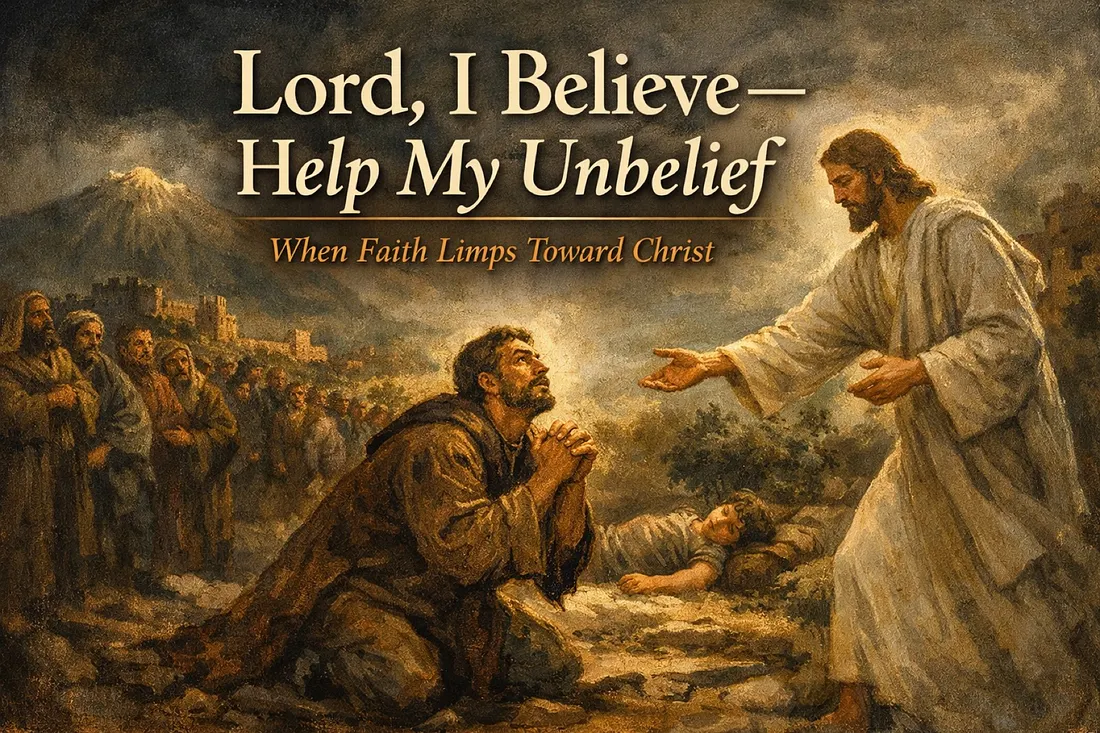
O: In the first passage, a desperate father brought his suffering son to Jesus’ disciples, but they could not heal him. His son had suffered since childhood, so this father had likely carried years of grief, disappointment, and exhausted hope. Then he heard about this miracle-working rabbi and thought maybe this was finally a way out.

However, when he brought his son to them, the disciples failed to heal him, he was disappointed yet again. No wonder when Jesus finally showed up (after the transfiguration! But he didn’t know that) he said, “But if you can do anything, take pity on us and help us.”

Jesus almost sounded offended, “If you can? Everything is possible for one who believes.”

No wonder the father desperately cried, “I do believe; help me overcome my unbelief!” He didn’t have much faith at that point, but he was desperate, and he brought the little faith he had to the right person.

And Jesus demonstrated His power and healed the boy.

Then in the second passage, Jesus saw a fig tree that was “in leaf” but had no fruit. Fig trees of the kind found in Israel can produce early small figs, sometimes called “early figs” or “breba” fruit, before the main crop. These early figs may appear around the time the leaves come out. So, if you see a tree full of leaves before the main season, you would expect there to be some early fruit.

This became a living parable of the religious leaders and the Temple establishment. They had the appearance of faith but no spiritual fruit. They had the leaves but no figs. So they fell under the curse the same way as illustrated by the fig tree Jesus cursed.

The tree looked fruitful from a distance because it was leafy, so it invited inspection, but it proved barren—making it an apt symbol for outward religiosity without corresponding fruit.

A: In the first story, the man didn’t have any polished religious image. He had no beautiful robes, no fancy theology. Even his faith was frayed, mixed with unbelief. But he was desperate, and he put his trust in Jesus. Jesus showed mercy and healed his son, in spite of his imperfect faith.

In the second story, the priests, scribes, Sadducees and Pharisees had plenty of religious sophistication, but they rejected Jesus, having no true faith and fruit as a result – and so they fell under the curse of the fig tree. This also was repeated many times through history as churches became so caught up in the pomp and pageantry of official sanction but did not have the fruit of the Holy Spirit.

Therefore, we should trust Jesus even if our faith is imperfect, rather than being caught up in religiosity. This is not to say that you cannot have true faith if you’re in a formal traditional church. You certainly can. And it’s certainly possible to have fake faith for show only in a “contemporary” church. What matters is the heart, sincere trust in Jesus, however imperfect or desperate.

P: Father, thank You for Your grace that overcomes our imperfections. I confess that my faith is often imperfect and have mixed motives. May I always be sincere and following You, even in my shortcomings. I repent of my sins and put my trust in You. In Jesus’ name, amen.

Illustration created by ChatGPT.

Friday, June 12, 2026

Desperation - I believe, help my unbelief.

Today, instead of my usual Friday SOAP, my meditation on Mark 9:14-39 became the start of a song. Right now, I only have come up with the lyrics; haven’t figured out the music yet. (I might modify the lyrics when I put it to music later, I dunno yet.)

I was meditating on the passage, when it occurred to me, all the songs I know about “I believe, help my unbelief” are meditative, reflective songs. But in the original situation, the phrase is not a meditative phrase – it was a cry of desperation! The father wasn’t reflecting on faith – he was in despair that his son would ever be healed! The disciples had failed. Could Jesus do it? He didn’t know! That’s why he said what he said to Jesus. 

So I tried to come up with a song that echoed that desperation.

[Verse 1]

Coming down the mountainside,
The Lord beheld the scene;
The scribes and disciples argued there,
A crowd stood in between.

A father stepped before the Lord,
His voice was weak with grief:
“Teacher, I brought my only son,
But they brought no relief.”

[Verse 2]

“Since he was but a little child,
A spirit troubles him;
It casts him into fire and streams,
And leaves his body grim.

I begged Your followers for help,
To set my poor boy free;
They failed to drive the spirit out.”
He said, “Bring him to Me.”

[Chorus]

Lord, I believe! Help my unbelief!
My doubt is heavy and my trust is small.
I bring no mighty faith to win relief,
Just a shattered hope, and yet I bring it all.

I am hoping against hope You are the one,
I’m holding to the fraying edge of grief;
I have nothing left to offer for my son,
But “I believe, oh, help my unbelief!”

[Verse 3]

The spirit saw the Saviour near,
And threw him to the ground;
He writhed and foamed before them all,
While crowds stood gathered round.

“How long has he been suffering so?”
The Lord in mercy said.
“Since childhood, Lord, and every year
I’ve lived with fear and dread.”

[Verse 4]

“If You can do a thing for us,
Have mercy, Lord,” he cried.
Jesus answered, “If I can?
Why let your faith now hide?

All things are possible indeed
For those who will believe.”
Then tears broke from the father’s eyes,
This mercy to receive:

[Chorus]

Lord, I believe! Help my unbelief!
My doubt is heavy and my trust is small.
I bring no mighty faith to win relief,
Just a shattered hope, and yet I bring it all.

I am hoping against hope You are the one,
I’m holding to the fraying edge of grief;
I have nothing left to offer for my son,
But “I believe, oh, help my unbelief!”

[Bridge]

Not a perfect faith,
Not a fearless heart,
Just a father on his knees.
Lord, I cannot save my son,
So I beg you, Jesus, please.

[Verse 5]

Jesus saw the crowd draw near,
And spoke a stern command:
“You deaf and mute spirit, depart,
And leave at My demand.”

The spirit shrieked and left the boy,
Who lay as one long dead;
But Jesus took him by the hand,
And raised him up instead.

[Chorus 2]

Lord, I believe! Help my unbelief!
When shadows fall and future trials arise,
I will remember how You brought relief,
And chased the ancient terror from his eyes.

I will anchor to the victory You have won,
How You rescued us from tragedy and grief;
When You reached Your gentle hand to raise my son,
Lord, I believe! Oh, help my unbelief!

[Outro]

In the valley after glory,
In the struggle after light,
The Saviour meets the trembling soul,
And leads it through the night.


Note: I used several discussions with various AIs to help work through the ideas and help me with rephrasing my ideas with rhyme and meter.

Friday, June 5, 2026

Two-stage healing

S: Mark8:22-26


22 They came to Bethsaida, and some people brought a blind man and begged Jesus to touch him. 23 He took the blind man by the hand and led him outside the village. When he had spat on the man’s eyes and put his hands on him, Jesus asked, ‘Do you see anything?’

24 He looked up and said, ‘I see people; they look like trees walking around.’

25 Once more Jesus put his hands on the man’s eyes. Then his eyes were opened, his sight was restored, and he saw everything clearly. 26 Jesus sent him home, saying, ‘Don’t even go into the village.’

O: Oddly, Jesus’ healing seemed to be not complete the first time round, and he had to heal again. But this actually makes sense, given modern research.

Neurologist Oliver Sacks documented a case of Shirl Jennings, who was medically healed of blindness, but his brain had difficulty processing the visual information. It took him weeks and months to adapt to vision, and actually never managed to achieve completely normal visual processing. [1]

Others also documented other cases of people who had been healed of blindness needing time to relate objects they saw with what they had only experienced before by touch. [2]

So, perhaps Jesus healed the blind man twice because there were two things that needed fixing – first, the hardware: his physical ability to see, and second, the software: his cognitive ability to process what his eyes were seeing.

During my master's research, I worked a little with machine vision. It gave me a new appreciation for the miracle of sight. Even getting a computer to identify simple lines in engineering drawings was remarkably difficult. (This is now largely a solved problem; my research was decades ago.) If recognising lines is hard, how much more remarkable is the human ability to instantly recognise faces, trees, and people? [3]

A: Sometimes God’s work in my life unfolds in stages. I may pray for help, healing, guidance, or change, and the answer may not seem complete at first. Like the blind man, I may see something, but not yet clearly.

This passage reminds me that Jesus is not limited or struggling. He is Lord over both the miracle and the process. If His work seems gradual, there may be reasons I do not yet understand.

The blind man was honest with Jesus. He did not pretend that everything was clear. He simply said what he saw. I need to learn that kind of honesty in prayer too. Instead of pretending, giving up, or becoming quietly disappointed, I can tell Jesus where things still feel unresolved: “Lord, I can see a little, but not clearly yet.”

I also need to keep trusting Him after the first touch. Partial progress is not failure. It may be part of the process by which Jesus teaches me dependence, patience, and deeper faith. My responsibility is to stay with Him, be honest before Him, and trust Him until He brings clearer sight.

P: Father, when Your answer seems delayed, partial, or different from what I expected, help me not to give up or pretend. Teach me to be honest with You, to trust Your process, and to keep looking to Jesus until I see more clearly. In Jesus’ name, amen.

References

1.     Oliver Sacks, An Anthropologist on Mars: Seven Paradoxical Tales (New York: Alfred A. Knopf, 1995), chap. 2, “To See and Not See.” ISBN 0-679-43785-1

2.     Held, R., Ostrovsky, Y., de Gelder, B. et al. The newly sighted fail to match seen with felt. Nat Neurosci 14, 551–553 (2011). https://doi.org/10.1038/nn.2795

3.     Chai, I., Dori, D. (1992). Orthogonal Zig-Zag: An Efficient Method for Extracting Straight Lines from Engineering Drawings. In: Arcelli, C., Cordella, L.P., di Baja, G.S. (eds) Visual Form. Springer, Boston, MA. https://doi.org/10.1007/978-1-4899-0715-8_14

Note: The ideas are mine, but I did get some help from AIs to copyedit what I wrote.