Daddy blog

I started this blog when I was following the Life Journal Bible reading plan on YouVersion. (I've since completed that plan.) At that time, YouVersion didn't provide any way for people to respond to my notes, other than to "like" them. So this blog is here to remedy that problem. You may comment on my notes here in the comment section.
I also have a general blog.

Friday, June 12, 2026

Desperation - I believe, help my unbelief.

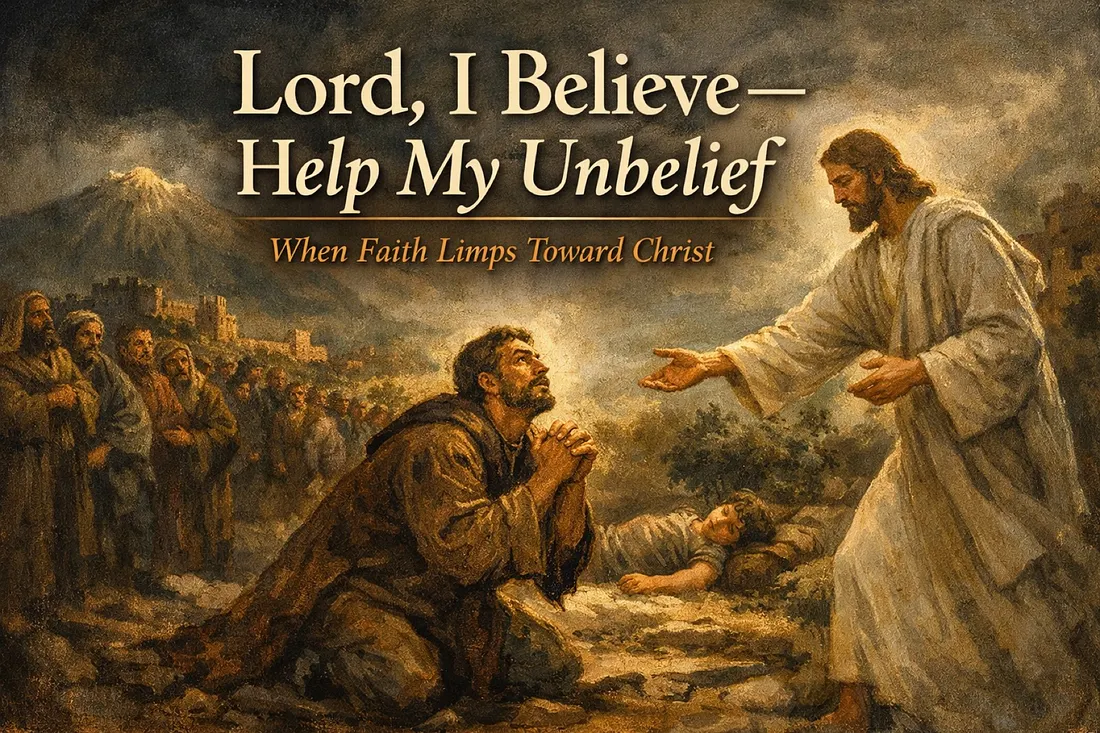
Today, instead of my usual Friday SOAP, my meditation on Mark 9:14-39 became the start of a song. Right now, I only have come up with the lyrics; haven’t figured out the music yet. (I might modify the lyrics when I put it to music later, I dunno yet.)

I was meditating on the passage, when it occurred to me, all the songs I know about “I believe, help my unbelief” are meditative, reflective songs. But in the original situation, the phrase is not a meditative phrase – it was a cry of desperation! The father wasn’t reflecting on faith – he was in despair that his son would ever be healed! The disciples had failed. Could Jesus do it? He didn’t know! That’s why he said what he said to Jesus. 

So I tried to come up with a song that echoed that desperation.
[Verse 1]

Coming down the mountainside,
The Lord beheld the scene;
The scribes and disciples argued there,
A crowd stood in between.

A father stepped before the Lord,
His voice was weak with grief:
“Teacher, I brought my only son,
But they brought no relief.”

[Verse 2]

“Since he was but a little child,
A spirit troubles him;
It casts him into fire and streams,
And leaves his body grim.

I begged Your followers for help,
To set my poor boy free;
They failed to drive the spirit out.”
He said, “Bring him to Me.”

[Chorus]

Lord, I believe! Help my unbelief!
My doubt is heavy and my trust is small.
I bring no mighty faith to win relief,
Just a shattered hope, and yet I bring it all.

I am hoping against hope You are the one,
I’m holding to the fraying edge of grief;
I have nothing left to offer for my son,
But “I believe, oh, help my unbelief!”

[Verse 3]

The spirit saw the Saviour near,
And threw him to the ground;
He writhed and foamed before them all,
While crowds stood gathered round.

“How long has he been suffering so?”
The Lord in mercy said.
“Since childhood, Lord, and every year
I’ve lived with fear and dread.”

[Verse 4]

“If You can do a thing for us,
Have mercy, Lord,” he cried.
Jesus answered, “If I can?
Why let your faith now hide?

All things are possible indeed
For those who will believe.”
Then tears broke from the father’s eyes,
This mercy to receive:

[Chorus]

Lord, I believe! Help my unbelief!
My doubt is heavy and my trust is small.
I bring no mighty faith to win relief,
Just a shattered hope, and yet I bring it all.

I am hoping against hope You are the one,
I’m holding to the fraying edge of grief;
I have nothing left to offer for my son,
But “I believe, oh, help my unbelief!”

[Bridge]

Not a perfect faith,
Not a fearless heart,
Just a father on his knees.
Lord, I cannot save my son,
So I beg you, Jesus, please.

[Verse 5]

Jesus saw the crowd draw near,
And spoke a stern command:
“You deaf and mute spirit, depart,
And leave at My demand.”

The spirit shrieked and left the boy,
Who lay as one long dead;
But Jesus took him by the hand,
And raised him up instead.

[Chorus 2]

Lord, I believe! Help my unbelief!
When shadows fall and future trials arise,
I will remember how You brought relief,
And chased the ancient terror from his eyes.

I will anchor to the victory You have won,
How You rescued us from tragedy and grief;
When You reached Your gentle hand to raise my son,
Lord, I believe! Oh, help my unbelief!

[Outro]

In the valley after glory,
In the struggle after light,
The Saviour meets the trembling soul,
And leads it through the night.


Note: I used several discussions with various AIs to help work through the ideas and help me with rephrasing my ideas with rhyme and meter.

Friday, June 5, 2026

Two-stage healing

S: Mark8:22-26


22 They came to Bethsaida, and some people brought a blind man and begged Jesus to touch him. 23 He took the blind man by the hand and led him outside the village. When he had spat on the man’s eyes and put his hands on him, Jesus asked, ‘Do you see anything?’

24 He looked up and said, ‘I see people; they look like trees walking around.’

25 Once more Jesus put his hands on the man’s eyes. Then his eyes were opened, his sight was restored, and he saw everything clearly. 26 Jesus sent him home, saying, ‘Don’t even go into the village.’

O: Oddly, Jesus’ healing seemed to be not complete the first time round, and he had to heal again. But this actually makes sense, given modern research.

Neurologist Oliver Sacks documented a case of Shirl Jennings, who was medically healed of blindness, but his brain had difficulty processing the visual information. It took him weeks and months to adapt to vision, and actually never managed to achieve completely normal visual processing. [1]

Others also documented other cases of people who had been healed of blindness needing time to relate objects they saw with what they had only experienced before by touch. [2]

So, perhaps Jesus healed the blind man twice because there were two things that needed fixing – first, the hardware: his physical ability to see, and second, the software: his cognitive ability to process what his eyes were seeing.

During my master's research, I worked a little with machine vision. It gave me a new appreciation for the miracle of sight. Even getting a computer to identify simple lines in engineering drawings was remarkably difficult. (This is now largely a solved problem; my research was decades ago.) If recognising lines is hard, how much more remarkable is the human ability to instantly recognise faces, trees, and people? [3]

A: Sometimes God’s work in my life unfolds in stages. I may pray for help, healing, guidance, or change, and the answer may not seem complete at first. Like the blind man, I may see something, but not yet clearly.

This passage reminds me that Jesus is not limited or struggling. He is Lord over both the miracle and the process. If His work seems gradual, there may be reasons I do not yet understand.

The blind man was honest with Jesus. He did not pretend that everything was clear. He simply said what he saw. I need to learn that kind of honesty in prayer too. Instead of pretending, giving up, or becoming quietly disappointed, I can tell Jesus where things still feel unresolved: “Lord, I can see a little, but not clearly yet.”

I also need to keep trusting Him after the first touch. Partial progress is not failure. It may be part of the process by which Jesus teaches me dependence, patience, and deeper faith. My responsibility is to stay with Him, be honest before Him, and trust Him until He brings clearer sight.

P: Father, when Your answer seems delayed, partial, or different from what I expected, help me not to give up or pretend. Teach me to be honest with You, to trust Your process, and to keep looking to Jesus until I see more clearly. In Jesus’ name, amen.

References

1.     Oliver Sacks, An Anthropologist on Mars: Seven Paradoxical Tales (New York: Alfred A. Knopf, 1995), chap. 2, “To See and Not See.” ISBN 0-679-43785-1

2.     Held, R., Ostrovsky, Y., de Gelder, B. et al. The newly sighted fail to match seen with felt. Nat Neurosci 14, 551–553 (2011). https://doi.org/10.1038/nn.2795

3.     Chai, I., Dori, D. (1992). Orthogonal Zig-Zag: An Efficient Method for Extracting Straight Lines from Engineering Drawings. In: Arcelli, C., Cordella, L.P., di Baja, G.S. (eds) Visual Form. Springer, Boston, MA. https://doi.org/10.1007/978-1-4899-0715-8_14

Note: The ideas are mine, but I did get some help from AIs to copyedit what I wrote.

Friday, May 29, 2026

One woman’s touch

S: Mark 5:24b-34

A large crowd followed and pressed around him. And a woman was there who had been subject to bleeding for twelve years. She had suffered a great deal under the care of many doctors and had spent all she had, yet instead of getting better she grew worse. When she heard about Jesus, she came up behind him in the crowd and touched his cloak, because she thought, “If I just touch his clothes, I will be healed.” Immediately her bleeding stopped and she felt in her body that she was freed from her suffering.

At once Jesus realised that power had gone out from him. He turned around in the crowd and asked, “Who touched my clothes?”

 “You see the people crowding against you,” his disciples answered, “and yet you can ask, ‘Who touched me?’”

But Jesus kept looking around to see who had done it. Then the woman, knowing what had happened to her, came and fell at his feet and, trembling with fear, told him the whole truth. He said to her, “Daughter, your faith has healed you. Go in peace and be freed from your suffering.”

O: So many people were touching Jesus, bumping into him, jostling, etc. in the crowd as Jesus made his way from the shore to Jairus’s house. Yet one woman’s touch was different. One woman’s touch made Jesus stop in his tracks! One woman’s touch, in faith, brought healing. One woman’s touch.

It’s not that the people crowding around Jesus were not interested in Jesus. They obviously were – otherwise, why would they have come crowding around him? But there was a qualitative difference between their interest in Jesus and that one woman’s. They were interested in Jesus – she put her faith in Jesus.

The crowd pressed against Jesus with curiosity and excitement. She reached for Jesus with desperate faith. Many touched him accidentally; she touched him intentionally. For twelve years she had lived with shame, weakness, loss, and isolation. And yet Jesus didn't simply let the healing happen quietly. Instead, he called her forward so that the one who had been known by her condition would now be known by his compassion.

A: Daily I encounter Jesus. Most days, I pray and read the Bible. But often, it’s just part of my routine. Many days, I touch Jesus… like the people crowding against him as he walked from the shore to Jairus’s house. How often do I touch him like that woman touched him?

P: Psalm 27:4 says “One thing I have asked of Yahweh, that I will seek after: that I may dwell in Yahweh’s house all the days of my life, to see Yahweh’s beauty, and to inquire in his temple.” I admit, Father, that I do not often feel like that. I’m filled with other things I’m seeking than to spend quiet time with you. Father, forgive me. May I learn to be content with you above all else. In Jesus’ name, amen.


Friday, May 22, 2026

Why Did Jesus Speak So That People Wouldn’t Understand?

S: Mark 4:9-12

Then Jesus said, “Whoever has ears to hear, let them hear.”

10 When he was alone, the Twelve and the others around him asked him about the parables. 11 He told them, “The secret of the kingdom of God has been given to you. But to those on the outside everything is said in parables 12 so that,

“‘they may be ever seeing but never perceiving,
    and ever hearing but never understanding;
otherwise they might turn and be forgiven!’[a]

O: Jesus quotes Isaiah 6, where Yahweh commissions Isaiah to preach to a hardened Judah. Isaiah’s preaching does not create innocent unbelief, but exposes and confirms rebellion already present. In the larger sweep of Isaiah, Judah’s refusal of God’s word leads toward national devastation, exile, ultimately culminating in the Babylonian captivity.

Jesus applies that same prophetic pattern to His own ministry: He’s announcing the Kingdom of God, but not everyone receives it. This is preceded by the Parable of the Sower – the same gospel seed is sown, but the condition of the heart determines the response. Some reject immediately, some respond shallowly, some are choked by worldly concerns, and some truly hear, accept, persevere, and bear fruit.

Jesus is not saying, “I arbitrarily do not want people forgiven.” He is saying that the mystery of the kingdom is given to those who draw near to Him in faith, humility, and repentance, while those repeating Israel’s old pattern of hardness remain blind even while hearing. The issue is not mere intelligence. The disciples themselves often misunderstand. The issue is the posture of the heart: whether one comes near, asks, listens, repents, and follows.

At the same time, a person’s heart condition is not necessarily static. People can later repent. Even in Isaiah’s larger context, judgment does not destroy God’s mercy; a remnant remains. Therefore, this passage warns us not to presume upon hearing the word, but to receive it with repentance, perseverance, and fruitfulness.

A: Spiritual understanding grows as we stay near Christ. I must not be content merely to hear God’s word outwardly. I must receive it inwardly with repentance, faith, and obedience. I should draw near to Christ in prayer, study of Scripture, and faithful living, trusting that spiritual understanding deepens as I remain close to Him and bear fruit in perseverance.

P: Lord Jesus, I thank You
with my whole life and soul, I do
My heart belongs to You,
I know You love me true

The only sacrifice
I can bring is my soul,
my body and my heart,
You can take me whole.

My riches are like rags
compared to You, my Lord
My works are not enough
the ones I could afford.

So take my heart, O Lord,
I offer it to You
Tell me now my Lord,
what You want me to do
Receive it all my Lord,
this body that was mine
until the end of time.

Amen


Friday, May 15, 2026

Subtle idols

S: Mark 2:16-17, 24, 27-28

Some of the teachers of the Law of Moses were Pharisees, and they saw Jesus eating with sinners and tax collectors. So they asked his disciples, “Why does he eat with tax collectors and sinners?”

Jesus heard them and answered, “Healthy people don’t need a doctor, but sick people do. I didn’t come to invite good people to be my followers. I came to invite sinners.”

Some Pharisees asked Jesus, “Why are your disciples picking grain on the Sabbath? They are not supposed to do that!”

Jesus finished by saying, “People were not made for the good of the Sabbath. The Sabbath was made for the good of people. So the Son of Man is Lord over the Sabbath.”

O:

We have a tendency to make an idol of our own rules and interpretations of the faith, of our own tribe, and hence end up pushing people away from Yahweh. We may excuse the wrong things people we support do, while emphasising the wrong things people we disagree with do.

Jesus came to reconcile the ungodly people to Yahweh. We are His ambassadors, so we should be in that same business. But too often, we let our own prejudices get in the way of that.

A: I need to repent of my own sins, and show God’s compassion to others, whether they are already with Christ or still outside the family of faith. Many or most of those tax collectors and sinners Jesus ate with were not yet converted, yet He openly fellowshipped with them. I must show that same love and welcome as well.

P: Father, give me your heart for those outside the family of faith. Help me to show Your love to them. Let me recognise my own sins and grow closer to You. In Jesus’ name, amen.

๐‹๐จ๐จ๐ค ๐–๐ก๐š๐ญ ๐˜๐จ๐ฎ๐ฏ๐ž ๐ƒ๐จ๐ง๐ž
For All The King’s People
By Rob Hibbitt

Look my people, look what you’ve done
And there is nothing new under the sun
In your freedom you’ve bowed down to gold
It′s the same story, that same story of old

Come now children, put down that calf
I want the whole heart not just the half
By all means sing, I love to hear your voice
But O my children, love is freedom’s choice

Look my people, where is your fruit
That Love and peace and kindness
Stemming from my Spirit root
You sing, and dance, while the poor they die
You worship me while the nations cry

Come now children, put down that calf
I want the whole heart not just the half
By all means sing, I love to hear your voice
But O my children, love is freedom’s choice

Look my people, it is all in my Word
Why chase compromise and the absurd
The nations blaspheme because of you
So repent, my people, ’cause I still love you

Come now children, put down that calf
I want the whole heart not just the half
By all means sing, I love to hear your voice
But O my children, love is freedom′s choice

Throw down that calf of gold
Remember the promise of old
You will be like the stars up in the sky
And a land of promise for you and I
Now throw off the yoke of lust
And in my Word alone trust

Look my people, it is all in my Word
Why chase compromise and the absurd
The nations blaspheme because of you
So repent, my people, ’cause I still love you

Come now children, put down that calf
I want the whole heart not just the half
By all means sing, I love to hear your voice
But O my children, love is freedom′s choice

Come now children, put down that calf
I want the whole heart not just the half
By all means sing, I love to hear your voice
But O my children, love is freedom’s choice.

By the way, I just discovered this artist today. I mentioned the line “The nations blaspheme because of you” in a conversation with Eric Skattebo and he thought I was referring to a song, and so he Googled for the song and found this song. I was actually referring to Romans 2:24, but this was a serendipitous discovery because I really like the few songs I’ve since listened to from this channel.

Friday, May 8, 2026

Persist in repentance

S:

1 Kings 21:21, 25, 27-29 Behold, I will bring evil on you, and will utterly sweep you away and will cut off from Ahab everyone who urinates against a wall, and him who is shut up and him who is left at large in Israel.

But there was no one like Ahab, who sold himself to do that which was evil in Yahweh’s sight, whom Jezebel his wife stirred up.

When Ahab heard those words, he tore his clothes, put sackcloth on his body, fasted, lay in sackcloth, and went about despondently. Yahweh’s word came to Elijah the Tishbite, saying, “See how Ahab humbles himself before me? Because he humbles himself before me, I will not bring the evil in his days; but I will bring the evil on his house in his son’s day.”

2 Kings 3:1-2

Now Jehoram the son of Ahab began to reign over Israel in Samaria in the eighteenth year of Jehoshaphat king of Judah, and reigned twelve years. He did that which was evil in Yahweh’s sight, but not like his father and like his mother, for he put away the pillar of Baal that his father had made.

2 Kings 6-9

When Syria repeatedly attacked Israel, God had Elisha warn Jehoram many times where he would be, until the king of Syria thought he had an Israelite spy in his camp, but then when he was told it was the prophet, he tried to kill the prophet, but God blinded them so that Elisha could lead them into Samaria where they were shown Yahweh’s power, so they stopped attacking Israel.

But later, the next king of Syria, Ben Haddad, invaded again, but God didn’t warn Jehoram anymore and Samaria besieged and staving, and Jehoram said “God do so to me, and more also, if the head of Elisha the son of Shaphat stays on him today.”

But the next day, God miraculously made the Syrians run away, and Samaria was saved.

However, some time after that, Elisha instructs one of his disciples to anoint Jehu to enact the earlier pronounced judgment on the House of Ahab, and Jehu kills him.

O: At first, we might wonder: “there was no one like Ahab, who sold himself to do that which was evil in Yahweh’s sight” yet when he showed remorse (though temporarily), God postponed that judgment to his son’s time.

Yet, his son Jehoram seemed less evil, having “put away the pillar of Baal”. Yet did Yahweh jinx him by the curse on Ahab earlier? Didn’t Yahweh say not to punish the children for the sins of the parents? (Ezekiel 18:19-20)

Then there’s the interesting thing: Yahweh first helps Jehoram against Syria by sending Elisha to warn him whenever they would attack. But then later He allows an attack so severe Ben Haddad had actually besieged Samaria till they were resorting to cannibalism from their hunger! And then Jehoram demanded Elsha’s life before God intervened and rescued them.

What’s the deal there?

My theory is: Jehoram did make steps towards Yahweh… but didn’t persist. Because if there’s anything the Book of Jonah taught us, it’s that God always has an implicit “unless they repent” clause on all His judgments even if it’s not stated. Even the Ninevites knew that.

So my theory is that God sent Elisha to warn Jehoram of the Syrian attacks at first because Jehoram was at least kind of trying to follow Yahweh. But then he drifted back to the bad old ways. So God allowed Syria to attack. But I’m guessing that Jehoram didn’t repent even after God delivered them miraculously from that siege.

So God had Elisha’s disciple anoint Jehu and enact the judgment earlier pronounced.

So: God is not unjust. While there are natural consequences that might harm one’s descendants, God does not judge a person’s offspring for their parent’s sins. And there is always an implicit “unless they repent” clause.

A: So we must always be quick to repent and turn back to God. And stay heading back to God. Both Ahab’s and Jehoram’s problem was an incomplete and temporary repentance – then going back to their bad old ways, which then brought back the judgment. Contrast that with David’s horrible sins of adultery and murder: when he repented, he stayed repented. Not that he never sinned again (he did.) But he kept heading back to God, even after later failures.

P: “Forgive me, Father, for I have sinned,” as the Catholic confession prayer goes. Father, I mess up again and again but I repent each time and head back towards You. Renew my mind and conform me to Your Son. May I be a good ambassador for You. In Jesus’ name, amen.


Friday, April 24, 2026

The Faithful Little Slave Girl

S: 2 Kings 5:1-3, 14-19

Now Naaman, captain of the army of the king of Syria, was a great man with his master, and honourable, because by him Yahweh had given victory to Syria; he was also a mighty man of valour, but he was a leper. The Syrians had gone out in bands, and had brought away captive out of the land of Israel a little girl, and she waited on Naaman’s wife. She said to her mistress, “I wish that my lord were with the prophet who is in Samaria! Then he would heal him of his leprosy.”

14 Then went he down and dipped himself seven times in the Jordan, according to the saying of the man of God; and his flesh was restored like the flesh of a little child, and he was clean. 15 He returned to the man of God, he and all his company, and came, and stood before him; and he said, “See now, I know that there is no God in all the earth, but in Israel. Now therefore, please take a gift from your servant.”

16 But he said, “As Yahweh lives, before whom I stand, I will receive none.”

He urged him to take it; but he refused. 17 Naaman said, “If not, then, please let two mules’ load of earth be given to your servant; for your servant will from now on offer neither burnt offering nor sacrifice to other gods, but to Yahweh. 18 In this thing may Yahweh pardon your servant: when my master goes into the house of Rimmon to worship there, and he leans on my hand, and I bow myself in the house of Rimmon. When I bow myself in the house of Rimmon, may Yahweh pardon your servant in this thing.”

19 He said to him, “Go in peace.”

So he departed from him a little way.

O: This is one of my favourite stories in the Bible.

Imagine being a little girl, growing up peacefully with parents who taught you to worship Yahweh, the one true God. They taught you to pray, to trust Him, and to know that He is faithful.

Then disaster strikes.

Syrian raiders invade. Your family is torn apart. Your parents are killed, and you are carried away as a slave into a foreign land.

And not just to any household—you are given to serve in the house of Naaman, commander of the army that may have destroyed your home.

You weep. You grieve. You feel abandoned.

But then you remember Yahweh.

You remember what your parents taught you: that even in calamity, Yahweh has not forsaken you. He still loves you. He still cares for you.

So in a strange land, you remain faithful. You learn the Syrian language. You learn the hard life of a servant. And through it all, you keep praying.

Over time, the household you serve is no longer made up only of strangers. You come to know them.

But they do not know Yahweh.

They worship Rimmon, the god of storm and war—powerful, feared, a god associated with thunder and victory in battle.

Then one day you learn that Naaman, your master, suffers from a terrible disease.

And an extraordinary thought rises in your heart:

The God of Israel can heal him.

His prophet Elisha can be the instrument of that healing.

And so, instead of bitterness, you choose compassion.

Instead of silence, you bear witness.

You tell your mistress, “If only my master would see the prophet in Samaria…”

And wonder of wonders—Naaman listens.

He goes to Israel.

He meets the prophet.

He washes in the Jordan.

And he returns changed.

Not only healed in physically—but healed spiritually.

The conqueror comes home worshiping Yahweh.

The warrior bows before the God of Israel.

And all because a little slave girl, faithful in suffering, spoke one word of hope.

What an awesome epic movie this would make! So I guided AI to make the following movie poster ๐Ÿ˜

Naaman was powerful, honoured, and victorious, yet was helpless before leprosy. The little Israelite slave girl was powerless, unnamed, and captive, yet she is the one who speaks the true word that sets healing in motion. God uses the weak to reach the strong, and His mercy extends even to Israel’s enemy.

A: God doesn’t desire the wicked to perish, but that they’d repent and be saved. (Ezekiel 18:23) We are ambassadors for Christ, and we are to be salt and light to the world, sharing His love and salvation with everyone – including those we think of as enemies. (2 Corinthians 5, Matthew 5, Matthew 28, John 13.)

Let the little faithful little slave girl inspire us to go and do likewise!

P: Father, thank You for Your mercy to sinners and enemies through Jesus Christ. Keep me from bitterness, fear, and silence. Make me faithful like this little servant girl, ready to speak one true word at the right time. Use even my weakness to point others to Christ. In Jesus’ name, amen.

Friday, April 10, 2026

Great Jumpin' Jehoshaphat

S: 1 Kings 22:2-5  In the third year, Jehoshaphat the king of Judah came down to the king of Israel. The king of Israel said to his servants, “You know that Ramoth Gilead is ours, and we do nothing, and don’t take it out of the hand of the king of Syria?” He said to Jehoshaphat, “Will you go with me to battle to Ramoth Gilead?”

Jehoshaphat said to the king of Israel, “I am as you are, my people as your people, my horses as your horses.” Jehoshaphat said to the king of Israel, “Please inquire first for Yahweh’s word.”

O: Jehoshaphat was a follower of Yahweh, but he allied himself with Ahab, who persecuted the prophets of Yahweh. It’s not clear from the text why he did that. Perhaps he was afraid of invaders and wanted allies.

I also find it interesting that he recognized that Ahab’s prophets did not speak for Yahweh, and asked for a real prophet of Yahweh, and they called Micaiah, who prophesied that they would lose. Yet Ahab persisted, and Jehoshaphat went with him, even as much as to wear royal robes while Ahab dressed ordinarily so that the Syrians would attack him instead of Ahab. But God’s word still prevailed, and Ahab was killed. God spared Jehoshaphat, but rebuked him in 2 Chronicles 19:2-3 “Should you help the wicked, and love those who hate Yahweh? Because of this, wrath is on you from before Yahweh.” But it also affirmed, “Nevertheless there are good things found in you, in that you have put away the Asheroth out of the land, and have set your heart to seek God.”

In the end, he let Ahab’s daughter Athaliah marry his son Jehoram, and Jehoram ended up following in Ahab’s ways. Finally, when Jehu brought God’s judgment on the house of Ahab, Jehoram’s son Ahaziah was also killed because he happened to go visit his uncle, King Joram of Israel, and Athaliah usurped the throne of David, and tried to kill all the descendants of David, but God rescued one, Joash, and the Athaliah was executed and the throne of David restored.

Jehoshaphat had enough spiritual discernment to distrust Ahab’s prophets and ask for a true prophet of Yahweh. Yet after hearing Micaiah’s clear warning, he still went into battle with Ahab. This shows that spiritual discernment without obedient separation from evil is incomplete. He could identify falsehood, but he did not fully act on the truth he received. God therefore both spared him and rebuked him. His compromise did not end with one battle; it extended into family alliance with Ahab’s house, and that compromise later wounded the Davidic kingdom through Athaliah.

A: “Do not be unequally yoked” (2 Corinthians 6:14) is usually invoked nowadays in the context of marriage, but it applies not only to marriage but also to serious partnerships that bind us to people who oppose God, like what happened between Jehoshaphat and the house of Ahab.

Not every cooperation with unbelievers is wrong, but alliances become sinful when they require shared moral direction, compromise of obedience, or practical support for wickedness. Jehoshaphat shows that it is possible to love God sincerely and still fail in boundary-setting. True discernment is not only recognizing the word of God, but ordering our loyalties and actions by it, even under pressure.

Discernment is not just recognizing truth — it is acting consistently with it under pressure.

P: Father, help me to be discerning when having to partner with a nonbeliever; when we could legitimately partner with them do to something good, and when it’ll cause us to compromise with evil. In Jesus’ name, amen.

Friday, April 3, 2026

Naboth the martyr

S: 1 Kings 21

O: When we list martyrs, we tend not to think of Naboth. In fact, when many of us, lacking the original context, may not even realise Naboth was a martyr. We might think, “Ah, he was a man who didn’t want to sell his land to King Ahab, and so Queen Jezebel had him framed and executed.”

But Naboth refused not because he was merely attached to his land, but because he was obeying the Law of Moses: Leviticus 25:23 says, “The land shall not be sold in perpetuity, for the land is mine; for you are strangers and live as foreigners with me.”

He might well have allowed King Ahab to lease the land – that was permitted under the Law of Moses – but then it would revert to his family in the Year of Jubilee. But Ahab didn’t ask for that – he wanted to buy the land in perpetuity.

So, Naboth was killed because he obeyed Yahweh.

A: Obeying God can carry a real cost. He does not always spare His people from death in this world. Naboth was killed for obeying Yahweh. In the same way, Christians in our own time have been killed for belonging to Christ, such as the 21 Egyptian Christians, along with one Christian from Ghana, whom Daesh executed publicly on video on a beach near Sirte in Libya in 2015. They called on Jesus even as Daesh filmed them being executed. They became an incredible testimony to the world in their martyrdom, so Daesh inadvertently ended up spreading the Gospel!

As Jesus said in Matthew 10: 28, “Don’t be afraid of those who kill the body, but are not able to kill the soul. Rather, fear him who is able to destroy both soul and body in Gehenna.”

Most of us are not called to martyrdom. But this Good Friday, as we remember Christ’s sacrifice on the cross, let us resolve that we will always stand for Christ and follow Yahweh in both small and big ways.

P: Father, help me to follow you in the little things as well as the big things. Help me to flee temptation and run to you. Strengthen me to obey you whatever the cost. In Jesus’ name, amen.


Friday, March 13, 2026

Only one hero

S: 1 Kings 5:3 "You know that David my father could not build a house for the name of Yahweh his God because of the wars which were around him on every side, until Yahweh put his enemies under the soles of his feet."

O: 1 Chronicles 22: 8-10 provides the background to this: But Yahweh’s word came to me, saying, ‘You have shed blood abundantly and have made great wars. You shall not build a house to my name, because you have shed much blood on the earth in my sight. Behold, a son shall be born to you, who shall be a man of peace. I will give him rest from all his enemies all around; for his name shall be Solomon, and I will give peace and quietness to Israel in his days. He shall build a house for my name; and he will be my son, and I will be his father; and I will establish the throne of his kingdom over Israel forever.’

As I have observed in earlier blog posts, David committed a lot what would be considered war crimes today – he killed prisoners of war, he exterminated entire tribes, including women and children, etc. But God did not reprimand him for killing so many people – instead, God reprimanded him for killing one man – Uriah – in trying to cover up his adultery with Bathsheba.

One lesson I had drawn from that earlier was that God distinguishes between sins David committed knowing he was wrong, and sins he committed in ignorance, and in God’s mercy, he deals graciously with human blindness.

Today’s SOAP illustrates that, while God gives us grace for those things, they still do have consequences. The people David unjustly killed are still dead. And God could not permit him to build his temple because of the blood on his hands. God can ordain a kingdom purpose through David’s reign while still marking killing people as unfitting for the temple.

So we distinguish between God’s sovereign use of war in history and God’s delight in peace, holiness, and covenant obedience. Even when violence occurs within redemptive history, Scripture does not let us become casual about bloodshed.

God truly established David’s kingdom, but He did not allow David to build the temple because David’s reign was marked by warfare and bloodshed. This means Scripture neither denies God’s historical purposes in war nor treats violence as morally light. The temple pointed to God’s dwelling in peace, so a man of war was not the fitting builder. David was useful in God’s plan, but not morally ultimate. The kingdom needed a greater Son than David.

A: We must not assume that just because God used someone effectively that God endorses everything he or she does. God does not glorify violence, even though he may have used it for good – God works all things for good for those who love God, who are called according to his purpose (Romans 8:28). The acts are not necessarily good in themselves, but God still uses them for good.

So, being used by God does not mean all one does is equally fitting or ideal. We must not glorify force, and must not idolise a powerful man like David, but look to Christ, the true King of peace.

P: Lord, make me humble, truthful, and peace-loving. Teach me to trust Christ, not flawed human strength. Amen

Friday, March 6, 2026

Outsiders inside


S: 2 Samuel 23-24

O: Back in Deuteronomy 7:1-2, it says “When Yahweh your God brings you into the land where you go to possess it, and casts out many nations before you—the Hittite, the Girgashite, the Amorite, the Canaanite, the Perizzite, the Hivite, and the Jebusite—seven nations greater and mightier than you; and when Yahweh your God delivers them up before you, and you strike them, then you shall utterly destroy them. You shall make no covenant with them, nor show mercy to them.”

And back in Deuteronomy 23:3, it says “An Ammonite or a Moabite shall not enter into Yahweh’s assembly; even to the tenth generation shall no one belonging to them enter into Yahweh’s assembly forever”.  

Yet, here in 2 Samuel 23-24 we see, as part of the people of God, Uriah the Hittite, Zelek the Ammonite, and Araunah the Jebusite!

And don’t forget, the whole book of Ruth – Ruth being a Moabite!

How? Did God contradict himself?

Nope. The Book of Jonah is a huge example of this. “In forty days, Nineveh will be overthrown!” No ifs, buts or exceptions. Yet, when they repent, God “went back against His word!”

Except that everyone knew that there was that implicit “unless you repent” – Jonah knew, that’s why he refused to go warn them in the first place, and the Ninevites knew, which is why they repented and were saved.

So when we see these seemingly “blanket condemnations”, we must remember, there is always an implicit “unless they repent”.

As Ezekiel 33:11 says, “As I live,” says the Lord Yahweh, “I have no pleasure in the death of the wicked, but that the wicked turn from his way and live. Turn, turn from your evil ways!”

A: As Ruth the Moabite declared, “Your people will be my people, and your God my God.” (Ruth 1:16)

When we sin, we need to confess our sins, for God is faithful and just to forgive us of our sins and to cleanse us from all unrighteousness. (1 John 1:9)

Isaiah 1:18 “Come now, and let’s reason together,” says Yahweh: “Though your sins are as scarlet, they shall be as white as snow.  Though they are red like crimson, they shall be as wool.”

Isn’t God wonderful? Let’s repent and turn back to Him!

P: Father, thank You for your wonderful grace and for Jesus’ sacrifice to save us.  In Jesus’ name, amen.


Friday, February 27, 2026

The Hatchet Man

S: 2 Samuel 20:8–13 — Joab murders Amasa through deception, greeting him like a brother and then striking him. Afterwards, he calmly resumes command as if nothing has happened.

O: David had given Amasa Joab’s position as commander of the army of Israel. He likely did this to consolidate the two sides after the civil war with Absalom, and perhaps because he was angry with Joab for killing Absalom when he had expressly commanded him not to.

When Sheba ben Bichri launched a new rebellion and David sent Amasa to deal with it, Joab seized the opportunity to murder him, thereby securing his return as head of the army.

Joab functioned as David’s hatchet man, rather like Chuck Colson was for Richard Nixon. David relied on Joab to do his dirty work time and again — for example, in the matter of Uriah, Bathsheba’s husband. Joab also confronted David when his behaviour threatened the stability of the kingdom, such as during his excessive mourning for Absalom.

David may have felt unable to deal with Joab’s murders (yes, murders, in plural — he had earlier murdered another rival whom David had promoted for similar reasons: Abner, Saul’s commander) because Joab seemed too indispensable. David’s own moral failures may have weakened his ability to confront Joab decisively.

He was fiercely loyal in public, ruthlessly self-serving in practice, maintaining the kingdom’s “efficiency” by eliminating rivals. Yet that efficiency was built on murder and deceit. The frightening reality is how quickly a community can be conditioned to move on once the evidence is removed (the body is taken off the road, and everyone carries on). God is not deceived by managed appearances; bloodguilt cries out to Him, and in time He brings true judgement — Joab eventually meets justice under Solomon. This is the moral shape of reality: sin’s consequences may be delayed, but they are never erased by usefulness.

Chuck Colson’s story shows that Joab’s path was not inevitable. Colson genuinely repented and was redeemed, later doing much good through Prison Fellowship. The difference is not “good PR” versus “bad PR”, but repentance versus self-protection. Justice fell on Joab; mercy is available to the repentant like Colson.

So I must ask: Where am I tempted to justify sinful methods because they seem necessary? Where am I hiding behind competence, loyalty, or “the cause”? God requires truth in the inward parts, and He will not allow bloodguilt, abuse, or manipulation to have the final word.

A: The end does not justify the means. I must remain faithful to God’s good way, even when the wrong way seems more “efficient”. When I am tempted to justify sinful methods, I must remember the lesson of Joab, David’s hatchet man. God requires truth in the inward parts, and He will not allow bloodguilt, abuse, or manipulation to prevail.

P: Father, guard my heart from the hatchet man’s ways — willing to harm others for personal gain. Help me always to treat people with Your love. In Jesus’ name, amen.


Notes:

I came up with this SOAP in a conversation with Kairos AI after reading 2 Samuel 20, as I struggled with what lesson could I draw from this horrible incident. The picture was based on an illustration from the 1862 Illustrirte Pracht-Bibel, updated by ChatGPT.

Friday, February 20, 2026

Consequences

S: 2 Samuel 12

7Nathan said to David, “You are the man! This is what Yahweh, the God of Israel, says: ‘I anointed you king over Israel, and I delivered you out of the hand of Saul. 8I gave you your master’s house and your master’s wives into your bosom, and gave you the house of Israel and of Judah; and if that would have been too little, I would have added to you many more such things. 9Why have you despised Yahweh’s word, to do that which is evil in his sight? You have struck Uriah the Hittite with the sword, have taken his wife to be your wife, and have slain him with the sword of the children of Ammon. 10Now therefore the sword will never depart from your house, because you have despised me and have taken Uriah the Hittite’s wife to be your wife.’

11“This is what Yahweh says: ‘Behold, I will raise up evil against you out of your own house; and I will take your wives before your eyes and give them to your neighbour, and he will lie with your wives in the sight of this sun. 12For you did this secretly, but I will do this thing before all Israel, and before the sun.’”

13David said to Nathan, “I have sinned against Yahweh.”

Nathan said to David, “Yahweh also has put away your sin. You will not die. 14However, because by this deed you have given great occasion to Yahweh’s enemies to blaspheme, the child also who is born to you will surely die.” 15Then Nathan departed to his house.

O: David repented so “Yahweh also has put away your sin. You will not die. However, because by this deed you have given great occasion to Yahweh’s enemies to blaspheme, the child also who is born to you will surely die.” Also, “the sword will never depart from your house” and “I will raise up evil against you out of your own house; and I will take your wives before your eyes and give them to your neighbour, and he will lie with your wives in the sight of this sun.”

New Testament believers, we know that “If we confess our sins, he is faithful and righteous to forgive us the sins and to cleanse us from all unrighteousness.” (1 John 1:9) The temptation, then, is to be too nonchalant about sin. But 2 Samuel 11-19 reminds us that sin has consequences, even when God forgives us when we repent.

A: I must remind myself daily that sin has terrible consequences:

  • It dishonours God.
  • It harms others.
  • It damages my witness.
  • It invites discipline.
  • It promises pleasure but produces death.

I must submit myself to God resist the devil (James 4:7) and take the way of escape when faced with temptation (1 Corinthians 10:13). Though the sin looks attractive (that’s why it’s tempting) in reality, it’s deadly! (James 1:14-15)

P: Father, let me always submit myself to You and resist the devil. Let me always take the way of escape when temptation comes. Let me remember that the wages of sin is death.  Keep me from sin. Let me fear dishonouring Your name and hurting the people around me more than I fear losing the pleasure. Give me a tender heart that repents quickly and takes the way of escape. Guard me from the death that sin brings. In Jesus’ name, amen.

Friday, January 23, 2026

A Lie, a Loaf, and a Lesson

S: 1 Samuel 21

O:
David lied to Ahimelek, and that lie ultimately led to the slaughter of Ahimelek and the entire priestly household—though Saul alone bore guilt for the murders themselves. David’s sin was the lie, not the violence.

Later, Jesus appeals to this episode in Matthew 12:1–8, Mark 2:23–28, and Luke 6:1–5 when His disciples pluck grain on the Sabbath and are accused by the Pharisees of breaking the Law. Jesus did not condone David’s lie. Rather, He pointed out that Ahimelek, a trained priest who knew the Law, permitted David and his men, in a moment of urgent human need, to eat the consecrated bread normally reserved for priests.

Jesus’ argument was that Scripture itself shows it can be legitimate to override rigid, technical interpretations of ritual law for higher purposes. “The Sabbath was made for man, not man for the Sabbath” (Mark 2:27). There are biblical precedents where a strict, wooden reading of ceremonial rules would condemn actions that God did not condemn. David eating the bread in a crisis is one example; priests working in the temple on the Sabbath is another (Matthew 12:5).

In effect, Jesus was telling the religious leaders: when ceremonial regulation comes into conflict with urgent human need, God does not treat merciful action as true lawbreaking. Their interpretation of the Sabbath was therefore wrong, because it crushed mercy instead of serving people. Jesus upheld the spirit of the law, not mere legalism.

It is also worth noting that David later felt the weight of his sin. In the following chapter, he confessed to Abiathar son of Ahimelek that his actions had contributed to the death of Ahimelek’s household.

A:
We need wisdom to discern where the balance lies. Some things are clear-cut: the ends do not justify the means, and lying to secure our own benefit is wrong. Yet there are extreme situations that force moral complexity—for example, when Corrie ten Boom and her family lied to Nazis to protect Jews they were hiding.

Appealing to “the spirit, not the letter” does not loosen God’s moral standards. Rather, it prioritises God’s ultimate good over legalism. Love God; love our neighbour. We must protect the innocent and refuse to aid evil, which is precisely what the ten Boom family did.

P:
Father, give us wisdom when we face difficult situations. Help us to obey Your Spirit and to act with truth, mercy, and courage. In Jesus’ name, amen.